
By Utkarsh Singh | Published: November 19, 2026
Generating 2,000 property leads means very little if your sales team struggles to bring even 20 potential buyers to the project site.
For real estate developers, the challenge is not always generating more enquiries. It is reaching the right buyers, building confidence in the project, and converting interest into bookings.
This is where choosing the right real estate marketing agency becomes a critical business decision.
With hundreds of digital marketing companies offering similar services, impressive presentations and attractive lead generation packages, identifying the right marketing partner can be difficult.
To choose the right real estate marketing agency in India, evaluate its industry experience, local market knowledge, lead quality strategy, advertising expertise, SEO capabilities, reporting transparency and ability to connect marketing performance with actual sales outcomes.
The right agency should understand your business beyond its advertising requirements.
This guide explains what developers, builders and property consultants should evaluate before hiring a real estate marketing partner.
What Does a Real Estate Marketing Agency Do?
A real estate marketing agency helps developers, builders and property businesses attract potential buyers, improve brand visibility, generate qualified enquiries and support property sales through targeted marketing strategies.
Its responsibilities extend beyond running advertisements and managing social media accounts.
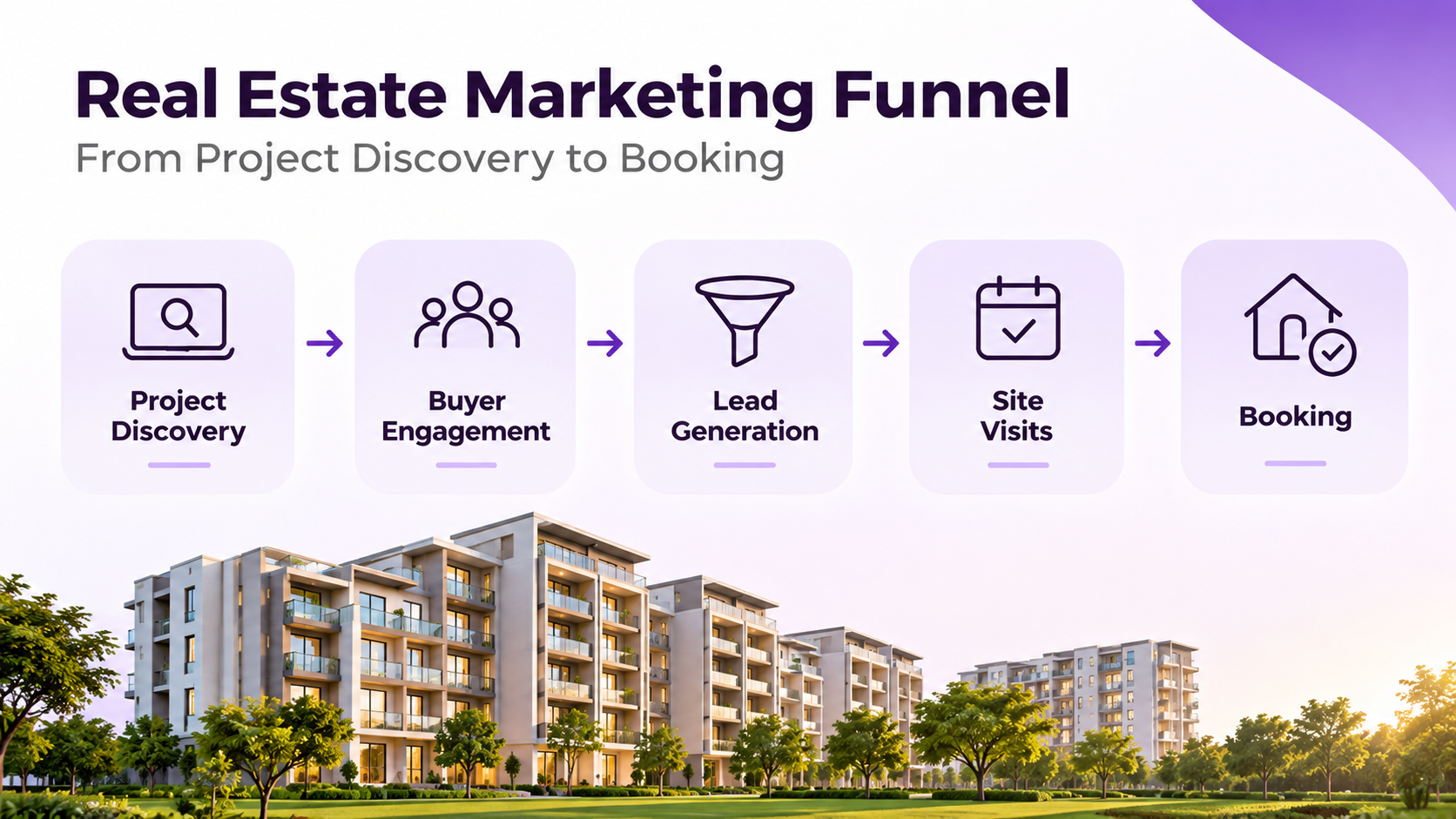
A capable agency connects multiple stages of the property buying journey:
- Market research and competitor analysis
- Project positioning and audience identification
- Brand awareness and demand generation
- Property lead generation and qualification
- Website and landing page optimisation
- Buyer engagement and retargeting
- CRM integration and lead tracking
- Marketing performance and conversion analysis
These activities should work together rather than operate independently.
For example, Google Ads may attract a buyer actively searching for an apartment, while project videos, location guides and remarketing campaigns can help that buyer make a more informed decision before scheduling a site visit.
Marketing creates the opportunity. An effective sales process helps convert that opportunity into a booking.
Why Choosing the Right Marketing Agency Matters in Real Estate
Buying a property is different from purchasing an everyday product.
Homebuyers consider location, affordability, connectivity, construction quality, possession timelines, financing options and developer reputation before making a decision.
Commercial property investors may evaluate rental potential, occupancy, tenant profiles and long-term investment considerations.
These decisions rarely happen immediately after someone sees an advertisement.
A real estate marketing agency must understand this longer buying journey and create campaigns accordingly.
There are also several challenges specific to property marketing in India:
- Competition between projects within the same micro-market.
- Changing inventory availability and pricing.
- Different expectations among end users, investors and NRI buyers.
- Regulatory requirements for property advertisements.
- Dependence on sales teams and channel partners.
- Long gaps between initial enquiries and final bookings.
An agency that understands these challenges can develop a more relevant strategy instead of applying the same digital marketing approach used for other industries.
How to Choose the Right Real Estate Marketing Agency in India: 14 Factors to Consider

1. Look for Relevant Real Estate Industry Experience
Working with a real estate client does not automatically make an agency a real estate marketing specialist.
What matters is whether the agency understands projects similar to yours.
A marketing strategy for affordable apartments in Greater Noida will differ from one for luxury villas in Bangalore or commercial office spaces in Gurugram.
When reviewing an agency's portfolio, look beyond the number of clients and attractive campaign designs.
Ask about the types of projects it has handled, their price segments, target markets, campaign objectives and measurable results.
Request case studies that explain:
- The original marketing challenge.
- The strategy implemented.
- Campaign duration and advertising investment.
- Lead qualification criteria.
- Site visits and bookings, where available.
An agency should be able to explain why a campaign worked, not just present the numbers.
Where client confidentiality prevents sharing sensitive information, anonymised reports with meaningful performance data can still help demonstrate expertise.
2. Evaluate Its Understanding of the Local Property Market
India is not a single real estate market.
Buyer preferences, property prices, infrastructure development and competition vary significantly between cities and even between neighbourhoods within the same city.
For example, a residential project near Whitefield in Bangalore may emphasise access to employment hubs, while a project along the Noida Expressway may focus on connectivity, social infrastructure and residential development.
A luxury development in Gurugram may require a different positioning strategy based on lifestyle, privacy and brand perception.
A capable agency should research the project's micro-market before recommending advertising channels or budgets.
Developers evaluating a real estate marketing agency in Bangalore, for instance, should look for an understanding of relevant residential corridors, competing projects and local buyer preferences rather than simply city-wide campaign targeting.
Local knowledge should translate into actionable marketing decisions.
3. Check Whether the Agency Offers a Customised Marketing Strategy
Every project has different business objectives.
A newly launched residential development may need awareness and demand generation. An ongoing project could require better lead qualification, while a ready-to-move development may need campaigns focused on available inventory and possession readiness.
Before proposing a strategy, an agency should understand:
- Project location and development stage.
- Available inventory and property configurations.
- Price range and payment plans.
- Target buyer profiles.
- Competing developments.
- Marketing budget and sales objectives.
- Current lead-to-booking performance.
Be cautious if an agency immediately recommends a fixed advertising package without understanding these details.
A useful real estate marketing strategy starts with identifying the business problem, not selecting an advertising platform.
4. Prioritise Lead Quality Over Lead Volume
One of the biggest mistakes developers make when hiring a marketing agency is comparing proposals solely on cost per lead (CPL).
A cheaper lead is not necessarily a better lead.
A qualified property enquiry should have a reasonable match with the project's location, price range, property type and purchase requirements.
Consider this hypothetical example involving two agencies working with the same advertising budget.
Agency A
- Advertising spend: ₹1,00,000
- Total leads: 1,000
- Cost per lead: ₹100
- Qualified leads: 100
- Completed site visits: 20
- Bookings: 2
Agency B
- Advertising spend: ₹1,00,000
- Total leads: 500
- Cost per lead: ₹200
- Qualified leads: 200
- Completed site visits: 60
- Bookings: 6
Agency A generates twice as many enquiries at half the cost per lead. However, Agency B generates three times as many site visits and bookings.
Agency A's advertising cost per booking is ₹50,000, while Agency B's is approximately ₹16,667.
These hypothetical figures illustrate why developers should evaluate the entire conversion funnel instead of judging campaigns by CPL alone.
An effective real estate lead generation strategy should focus on buyer relevance, purchase intent and the actual contribution of marketing to the sales pipeline.
5. Assess Google Ads and Meta Ads Expertise
Google Ads and Meta Ads serve different purposes within real estate digital marketing.
Google Search Ads can capture existing demand from people actively searching for properties, locations or specific project types.
Meta Ads across Facebook and Instagram can introduce projects to potential buyers, generate interest and support remarketing.
Neither platform is universally better.
An experienced agency should know when to use each channel, how to test campaign performance and when to adjust budget allocation.
When evaluating paid advertising expertise, ask the agency to explain its approach to keyword research, geographic targeting, negative keywords, creative testing, conversion tracking and offline conversion measurement.
It should also be able to explain how it manages irrelevant enquiries, duplicate leads and poor-performing campaigns.
Professional Google Ads services should involve continuous optimisation based on meaningful business outcomes rather than simply increasing advertising expenditure.
6. Evaluate SEO and Long-Term Organic Growth Capabilities
Paid advertising can generate immediate visibility, but relying exclusively on advertisements makes property businesses dependent on continuous media spending.
Search engine optimisation helps developers build organic visibility for relevant property searches, location-based queries and buyer research topics.
An experienced real estate SEO agency should understand how to optimise:
- Project and property listing pages.
- Location-specific landing pages.
- Residential and commercial property keywords.
- Website architecture and internal linking.
- Technical SEO and mobile performance.
- Developer brand visibility.
- Informational content for property buyers.
SEO should also support emerging discovery channels, including AI-generated search answers.
Clear project information, accurate location details, structured content and reliable sources can help search engines and AI systems understand a website's content. However, no agency can guarantee inclusion in AI-generated recommendations.
Investing in real estate SEO services can help developers establish an organic acquisition channel alongside paid marketing.
7. Review the Agency's Creative and Branding Capabilities
Property buyers need more than attractive building renders.
They also need to understand what makes a development worth considering.
Effective real estate creatives communicate the project's positioning, practical benefits, lifestyle proposition and relevant differentiators.
A campaign promoting a family-oriented residential project might highlight usable living spaces, nearby schools and recreational facilities. A commercial development may require messaging focused on accessibility, business infrastructure and relevant investment considerations.
Ask the agency to show examples of advertising creatives, project launch campaigns, property videos, brochures and social media content.
Look for clarity of communication, not just visual appeal.
A strong creative team should understand what information matters to different buyer segments and how to communicate it across advertising formats.
8. Examine Its Website and Landing Page Expertise
Even a well-targeted advertising campaign can underperform if the landing page fails to meet buyer expectations.
A property landing page should answer essential questions before requesting contact details.
Depending on the project, this may include:
- Property configurations and indicative pricing.
- Project location and connectivity.
- Amenities and floor plans.
- Construction and possession status.
- Developer information.
- Applicable RERA registration details.
- Clear enquiry and site visit options.
Mobile usability is equally important. Buyers should not struggle with slow pages, intrusive pop-ups or unnecessarily complicated enquiry forms.
Ask the agency whether landing page development, testing and conversion optimisation are included in its proposal.
Generating traffic and converting that traffic are interconnected responsibilities.
9. Check Its CRM and Lead Management Approach
A lead generation campaign does not end when someone submits an enquiry form.
The enquiry must reach the right sales representative, receive a timely response and be tracked throughout the buying journey.
Without a clear lead management process, developers may lose genuine opportunities despite running effective campaigns.
A capable real estate marketing agency should be able to work with the developer's customer relationship management (CRM) system and establish processes for lead assignment, duplicate detection, source tracking and sales feedback.
For example, if several enquiries from a campaign are consistently marked as having insufficient budgets, the agency should review the pricing communication, targeting and campaign messaging.
Without that feedback, the same problem may continue for weeks.
Developers should also clarify how WhatsApp communication, follow-ups and lead nurturing will be handled, including appropriate consent and data protection practices.
10. Look for Transparent Reporting and Meaningful Performance Metrics
An attractive monthly presentation is not necessarily evidence of successful marketing.
Impressions, clicks, reach and website traffic help explain campaign performance, but they do not provide a complete picture of business outcomes.
A useful performance report should connect advertising expenditure with qualified enquiries, site visits and sales opportunities.
Ask the agency to provide a sample dashboard or anonymised reporting document.
The report should ideally show performance by campaign, lead source, audience segment and conversion stage.
It should also explain what has changed, why performance has improved or declined, and what actions the agency plans to take next.
Effective performance marketing for real estate requires using data to improve business outcomes, not simply presenting data after campaigns have run.
11. Make Sure You Retain Ownership of Marketing Assets
Account ownership is often overlooked during agency selection.
Developers should establish appropriate ownership and administrative access to their core digital assets from the beginning.
These may include Google Ads accounts, Meta business assets, Google Analytics, Google Search Console, domain names, websites, CRM data and campaign tracking systems.
The agreement should also clarify ownership or licensing rights for creatives, website source code and other materials produced during the engagement.
If you change agencies, you should have an agreed process for retaining your campaign history, customer data and essential business assets.
An agency can manage your marketing infrastructure without unnecessarily restricting your control over it.
12. Evaluate Knowledge of RERA and Advertising Compliance
Real estate marketing in India involves legal and regulatory responsibilities that agencies should understand.
Under Section 3 of the Real Estate (Regulation and Development) Act, 2016, projects requiring registration generally cannot be advertised or marketed before obtaining that registration.
Section 11(2) requires promoters' advertisements for registered projects to prominently include the relevant regulatory authority's website address and the project registration number.
Developers can review the official Real Estate (Regulation and Development) Act, 2016 for the applicable provisions.
Additional advertising requirements may vary by state and regulatory authority.
A responsible property marketing agency should use approved project information, verify advertising claims with the developer and avoid misleading statements regarding possession, amenities, pricing or investment returns.
Before launching campaigns, establish a clear approval process involving the developer's authorised representatives and, where necessary, compliance advisers.
13. Assess Communication, Team Quality and Accountability
The team that presents an agency's proposal may not be the same team managing your campaigns.
Before signing an agreement, understand who will be responsible for strategy, paid advertising, SEO, creative production and account management.
It is also worth asking how frequently the agency reviews performance, manages urgent requests and communicates campaign changes.
A clear working relationship should include agreed reporting schedules, communication channels, approval timelines and defined responsibilities.
You should know who to contact when campaign performance declines or project information needs to be updated.
Good communication becomes particularly valuable during time-sensitive launches, inventory changes and promotional campaigns.
14. Check How the Agency Works With Your Sales Team
Marketing and sales cannot operate as completely separate functions in real estate.
The marketing team must understand what happens after an enquiry is generated. The sales team needs context about the campaigns, buyer expectations and advertised offers.
For instance, a campaign may generate relevant leads, but poor follow-up can result in low site visit numbers. Alternatively, a strong sales team may struggle because the advertisements attract buyers outside the project's price range.
A capable agency should help identify where the problem exists.
Regular marketing and sales reviews can reveal:
- Common buyer objections.
- Budget mismatches.
- Reasons for missed site visits.
- Differences in conversion rates between lead sources.
- Changes in buyer preferences.
- Opportunities to improve campaign messaging.
This collaboration helps both teams work towards the same business objective instead of blaming each other when sales targets are missed.
What Services Should a Real Estate Marketing Agency Provide?
A full-service real estate marketing company may offer a combination of advertising, branding, technology and organic growth services.
However, developers should select services based on their business objectives rather than purchasing every available service.
Real Estate Lead Generation
Lead generation campaigns attract prospective property buyers through advertising, organic search, landing pages and other acquisition channels.
The objective should be generating relevant enquiries with a reasonable likelihood of progressing through the sales process.
Google Ads and Meta Ads
Paid advertising supports demand capture, project awareness, enquiry generation and remarketing.
Budget allocation should depend on campaign objectives, competition and the quality of sales opportunities generated by each platform.
Real Estate SEO
SEO improves organic visibility for project-related, location-based and informational property searches.
It is particularly useful for developers and property businesses looking to build a sustainable online presence across multiple projects.
Website and Landing Page Development
Websites function as digital information centres where buyers can explore projects, compare options and contact the developer.
Landing pages create more focused experiences for specific campaigns and buyer segments.
Social Media Marketing
Social media helps developers communicate construction updates, project features, brand milestones and property-related information.
A well-planned real estate social media marketing strategy can support buyer confidence alongside lead generation campaigns.
Content and Video Marketing
Project walkthroughs, neighbourhood guides, homebuying resources, floor plan explanations and informative videos help prospective buyers understand a development.
Useful content can also address objections that would otherwise require repeated explanations from the sales team.
Retargeting and Lead Nurturing
Not every interested buyer is ready to make an immediate decision.
Retargeting and permission-based follow-up communication help maintain engagement with prospective buyers who are still evaluating their options.
Analytics and Conversion Optimisation
Conversion tracking connects marketing activities with buyer actions.
Analytics helps identify which campaigns attract relevant prospects and where potential buyers disengage from the journey.
How Much Does a Real Estate Marketing Agency Cost in India?
The cost of hiring a real estate marketing agency in India depends on the project size, location, advertising competition, required services, campaign scope and level of agency involvement.
There is no universal fee that applies to every property business.
Developers should understand the different components of their total marketing investment.
Agency Management Fees
These cover strategy development, campaign management, optimisation, coordination and reporting according to the agreed scope.
Advertising Budget
This is the amount allocated to advertising platforms such as Google, Meta and relevant property portals.
Media expenditure should be clearly distinguished from agency fees.
Creative Production Costs
Property photography, video shoots, drone footage, architectural visualisation and other production requirements may be priced separately.
Website and Technology Costs
Landing pages, website development, CRM subscriptions, automation tools and tracking infrastructure may involve additional charges.
Common Agency Pricing Models
Real estate marketing agencies may charge through monthly retainers, project-based fees, a percentage of advertising spend, performance-linked compensation or a combination of these models.
Each structure has different advantages and limitations.
For example, a percentage-of-spend model may become expensive as media budgets increase, while performance-based agreements require clearly defined lead qualification and attribution rules.
Example of a Monthly Real Estate Marketing Budget
Consider a hypothetical campaign with the following monthly allocation:
- Advertising spend: ₹2,00,000
- Agency management fee: ₹40,000
- Creative production: ₹25,000
- Landing page and technology expenses: ₹15,000
The total marketing investment would be ₹2,80,000 before applicable taxes or other expenses.
This is an illustrative budget, not an industry-standard pricing estimate.
If the campaign produces four attributable bookings, the total marketing cost per booking would be ₹70,000.
Looking only at advertising expenditure would produce a figure of ₹50,000 per booking, understating the actual marketing investment.
Developers should therefore compare complete costs rather than agency retainers alone.
How to Choose a Marketing Agency Based on Your Real Estate Project
Different property developments require different marketing capabilities.
New Real Estate Project Launches
New launches require market research, positioning, awareness campaigns, creative production and coordinated demand generation, subject to applicable project registration and advertising requirements.
Choose an agency capable of planning campaigns around the launch schedule and sales team's capacity.
Ongoing Residential Projects
Existing residential developments may need campaigns focused on available configurations, inventory, construction progress and buyer objections.
An agency should analyse previous campaign data before recommending additional expenditure.
Luxury Real Estate Projects
Luxury property marketing requires a stronger emphasis on positioning, creative quality, buyer experience and relevant audience selection.
Low-cost lead generation alone is rarely an adequate objective for premium developments.
Commercial Real Estate
Office spaces, retail developments and other commercial assets may attract business owners, investors, tenants and institutional decision-makers.
The agency must understand the commercial proposition and create campaigns around the needs of these different audiences.
Regional and Local Real Estate Developers
Regional developers may benefit from neighbourhood-level search visibility, location-specific advertising, localised content and stronger community awareness.
The right marketing partner does not necessarily need to be the largest national agency. It needs the capabilities and market understanding relevant to the developer's objectives.
Projects Struggling With Low-Quality Leads
Increasing advertising expenditure should not be the first response to poor lead quality.
The agency should first investigate targeting, creative messaging, pricing communication, enquiry forms, CRM data and sales feedback.
Fixing the existing conversion problems may be more valuable than generating additional enquiries.
10 Red Flags When Hiring a Real Estate Marketing Agency
Not every warning sign becomes apparent during an initial agency presentation.
Developers should pay particular attention to the following:
- Guaranteed bookings without understanding the project or sales process.
- Unrealistically low lead cost promises.
- No evidence of relevant real estate marketing experience.
- Identical campaign strategies for every development.
- Lack of access to advertising accounts and campaign data.
- Unclear separation between agency fees and advertising expenditure.
- Reporting focused entirely on clicks, impressions and raw enquiries.
- No process for reviewing lead quality with the sales team.
- Unclear contractual deliverables or lengthy restrictive exit conditions.
- Misleading advertising claims or disregard for regulatory requirements.
A reliable agency should be comfortable discussing its limitations, explaining assumptions and answering difficult questions before an agreement is signed.
Questions to Ask Before Hiring a Real Estate Marketing Agency
An initial discovery meeting should help you understand how the agency thinks about your business.
Before making a decision, ask these questions:
- What would you need to learn about our project before recommending a strategy?
- Have you marketed developments with similar pricing, locations or buyer profiles?
- How would you differentiate our project from competing developments?
- What criteria do you use to define a qualified property lead?
- How would you divide our budget between advertising channels?
- What would you do if lead volume increased but site visits declined?
- How will you track enquiries through our CRM and sales process?
- Who will manage our campaigns on a day-to-day basis?
- How will you handle marketing asset ownership and account access?
- Which services are included in your fees, and which incur additional costs?
- How do you handle project advertising approvals and compliance requirements?
- What would the first 90 days of our engagement look like?
- How would we evaluate your performance beyond cost per lead?
- What happens to our accounts, data and creatives if we discontinue the engagement?
The quality of the answers can reveal more about the agency than the size of its portfolio or presentation.
How to Compare Real Estate Marketing Agencies: A 100-Point Evaluation Framework
When comparing multiple agencies, reviewing each proposal independently can make it difficult to reach an objective decision.
A weighted evaluation framework provides a more consistent approach.
The following suggested scorecard gives greater importance to the capabilities that influence marketing and sales outcomes.
- Real estate experience and verifiable results: 15 points
- Project understanding and market research: 15 points
- Lead quality and conversion strategy: 20 points
- Paid advertising and SEO expertise: 15 points
- Creative and landing page capabilities: 10 points
- CRM integration and performance reporting: 10 points
- Pricing transparency and asset ownership: 10 points
- Communication and team accountability: 5 points
Maximum score: 100 points.
Rate each agency against the same evidence requirements.
Use a scale of zero to five for each criterion, where zero indicates no evidence of capability and five indicates strong, relevant evidence.
Multiply the rating by the criterion's maximum points and divide by five.
For example, an agency receiving four out of five for lead quality strategy would receive 16 of the available 20 points.
This framework is a suggested decision-making tool, not an established industry certification or ranking system.
You can adjust the weight of each category according to your project requirements. A luxury developer might assign greater importance to branding, while a residential developer struggling with conversions might prioritise lead quality and CRM integration.
Certain issues, such as misleading advertising practices or refusal to provide agreed asset access, should be considered separately regardless of the final score.
How to Measure the Performance of Your Real Estate Marketing Agency
Developers need to evaluate more than the number of leads generated every month.
The following metrics provide a clearer picture of marketing effectiveness.
Cost Per Lead (CPL)
Measures how much advertising expenditure is required to generate an enquiry.
Formula: Advertising spend ÷ Total leads generated.
Lead Qualification Rate
Measures the proportion of enquiries that meet agreed buyer qualification criteria.
Formula: Qualified leads ÷ Total leads × 100.
Cost Per Qualified Lead (CPQL)
Measures the amount spent acquiring a relevant property enquiry.
Formula: Advertising spend ÷ Qualified leads.
Lead-to-Site-Visit Conversion Rate
Measures how many enquiries progress to a completed property visit.
Formula: Completed site visits ÷ Total leads × 100.
Cost Per Site Visit
Measures the advertising expenditure associated with generating a completed property visit.
Formula: Advertising spend ÷ Completed site visits.
Site-Visit-to-Booking Conversion Rate
Measures how effectively site visits progress into confirmed bookings.
Formula: Confirmed bookings from site visitors ÷ Completed site visits × 100.
Marketing Cost Per Booking
Measures the overall marketing investment required to generate an attributable booking.
Formula: Total marketing expenditure ÷ Attributable bookings.
Lead Response Time
Measures the time between an enquiry being received and the first meaningful sales response.
Tracking response time can help identify follow-up delays that affect conversion performance.
Marketing Attribution
Attribution helps determine which marketing channels contributed to enquiries, site visits and bookings.
A property buyer might first discover a project through Instagram, later search for the developer on Google and eventually submit an enquiry through the website.
Assigning all credit to the final interaction can overlook the contribution of earlier marketing activities.
Developers should agree on an attribution method, deduplication rules and reporting timelines with their agency.
For longer sales cycles, compare conversion rates using the same lead cohorts rather than dividing this month's bookings by this month's enquiries without considering when those buyers entered the funnel.
How to Evaluate a Real Estate Marketing Agency in the First 90 Days
The first three months can provide valuable information about whether the agency is building the right marketing foundation.
Days 1–30: Research, Setup and Initial Testing
The initial period should focus on project understanding, competitor research, positioning, tracking infrastructure, landing page readiness and campaign testing.
Evaluate whether campaigns are set up correctly and whether the sales team receives usable lead information.
Days 31–60: Optimisation and Lead Quality Improvement
Once sufficient campaign data becomes available, the agency should evaluate lead quality, test audience segments, improve advertising creatives and address conversion problems.
Sales feedback becomes particularly useful during this stage.
Days 61–90: Performance Review and Scaling Decisions
The agency should assess campaign efficiency, qualified lead volume, site visit performance and emerging sales pipeline opportunities.
Budget increases should be supported by evidence that additional investment is likely to contribute to business objectives.
This is a suggested review framework, not a guaranteed performance timeline. SEO growth and property bookings may require a longer evaluation period depending on the market, project and buying cycle.
What Makes Adwizly Different from Other Real Estate Marketing Agencies in India?
At Adwizly, we believe real estate marketing should be measured by the quality of business opportunities it creates, not simply the number of leads it generates.
As an AI-first real estate marketing agency in India, Adwizly combines industry expertise, buyer intelligence, artificial intelligence and data-driven marketing strategies to address the actual business challenges faced by developers.
Research Before Strategy
We don't believe in one-size-fits-all marketing packages. Our approach begins with understanding the project's location, competition, pricing, inventory, buyer behaviour and existing marketing challenges.
Every strategy is developed around the project's unique selling proposition and business objectives.
Qualified Buyers Over Lead Volume
Generating leads is easy compared to attracting buyers with genuine purchase intent.
Our real estate lead generation services focus on buyer relevance, budget compatibility, property preferences and purchase intent, helping sales teams concentrate on meaningful opportunities.
AI-Powered Marketing with Human Expertise
What differentiates Adwizly's approach is the integration of artificial intelligence with human marketing expertise.
From audience research and campaign optimisation to lead qualification and buyer behaviour analysis, we leverage AI to support better marketing decisions and improve operational efficiency.
Project-Specific Marketing Funnels
Every property has a different audience, price segment and buying journey.
We develop customised marketing funnels that connect project discovery, buyer engagement, lead generation, nurturing and site visits rather than relying on a standard campaign structure.
An Integrated Approach to Digital Growth
We look beyond individual advertising platforms. By combining real estate SEO services, real estate performance marketing, creative development, social media marketing and website optimisation, we help developers build both immediate demand and long-term organic visibility.
Our approach also considers emerging buyer discovery channels, including AI-powered search engines.
Marketing and Sales Alignment
We recognise that the responsibility of marketing does not end when a lead is generated.
By incorporating sales feedback, buyer objections and conversion insights into our marketing strategies, we help bridge the gap between lead generation and property sales.
Transparency, Ownership and Accountability
We believe developers should have clarity about their marketing investments, campaign performance and strategic direction.
Transparent reporting, clear communication, data-driven recommendations and client ownership of advertising assets form the foundation of our working approach.
A Growth Partner, Not Just a Marketing Agency
At Adwizly, we look beyond campaign execution. We focus on understanding what is holding a property business back and developing marketing strategies that address those challenges.
Whether it is a residential project launch, a luxury development, a commercial property or an existing project struggling with lead conversions, our approach is built around the developer's business objectives.
Partner with Adwizly to build a real estate marketing strategy that prioritises buyer quality, sustainable growth and meaningful business outcomes.
Why Consider Adwizly as Your Real Estate Marketing Partner?
Adwizly is an AI-first digital marketing and growth agency with a strategic focus on real estate marketing.
Our approach connects organic search visibility, paid advertising, lead generation, content, creative strategy and data-driven optimisation with the marketing objectives of property businesses.
Rather than treating digital marketing as a collection of independent services, we focus on building strategies around project requirements, buyer intent and measurable growth opportunities.
Whether you are evaluating a real estate digital marketing agency in Noida or planning campaigns for a development in Bangalore or Gurugram, your marketing strategy should reflect the realities of your specific property market.
Explore Adwizly to discuss your project, current marketing challenges and potential growth opportunities.
Final Checklist Before Hiring a Real Estate Marketing Agency
Before signing an agreement, make sure you have reviewed the following:
- Relevant real estate industry experience.
- Verifiable case studies and performance evidence.
- Understanding of your project and local property market.
- A customised marketing strategy.
- Clearly defined lead qualification criteria.
- Transparent pricing and deliverables.
- Advertising and digital asset ownership.
- CRM integration and sales coordination.
- Reporting schedules and performance indicators.
- Advertising compliance and approval procedures.
- Contract duration, notice period and exit conditions.
- A defined plan for the initial engagement.
Taking the time to evaluate these factors can help reduce unnecessary marketing expenditure and improve the working relationship between your agency and internal teams.
Conclusion
The right real estate marketing agency is not necessarily the one offering the lowest cost per lead, the largest service package or the most impressive presentation.
It is the one that understands your development, identifies the right buyers, communicates the project's value and measures marketing performance against meaningful business outcomes.
Before increasing your advertising budget, make sure your marketing foundation is capable of turning enquiries into genuine sales opportunities.
A better marketing strategy does not begin with spending more. It begins with understanding where your business is losing opportunities and deciding what needs to change.
Frequently Asked Questions
How do I choose the best real estate marketing agency in India?
Evaluate the agency's real estate experience, local market knowledge, verified case studies, lead qualification process, advertising expertise, SEO capabilities, reporting transparency and sales coordination. Choose a partner whose capabilities align with your project's specific requirements.
What services does a real estate marketing agency provide?
A real estate marketing agency typically provides lead generation, Google Ads, Meta Ads, SEO, social media marketing, project branding, content creation, landing page development, retargeting and performance analytics. Some agencies also support CRM integration and lead nurturing.
How much does a real estate marketing agency charge in India?
Agency charges depend on the services required, project size, advertising budget, location, creative requirements and campaign complexity. Developers should request an itemised proposal separating management fees, advertising expenditure, production costs and technology expenses.
Is Google Ads or Meta Ads better for real estate marketing?
Google Ads can capture demand from buyers actively searching for properties, while Meta Ads can support project discovery, awareness, lead acquisition and remarketing. The right channel mix depends on the project's audience, objectives and conversion performance.
How long does real estate digital marketing take to deliver results?
Paid advertising can begin generating enquiries shortly after campaigns launch. However, improving lead quality, completing site visits and generating bookings may take longer. SEO generally requires a sustained investment over several months, depending on competition and website authority.
How can developers measure the quality of real estate leads?
Developers can measure lead quality by reviewing contact validity, budget compatibility, location preference, property requirements, purchase timelines and progression towards site visits. Cost per qualified lead is generally more useful than cost per raw enquiry when assessing buyer relevance.
Should I hire a specialised real estate marketing agency or a general digital marketing agency?
A specialised agency may offer stronger property market knowledge and experience with real estate sales cycles. However, a general digital marketing agency can also be suitable if it demonstrates relevant experience, qualified personnel and an effective project-specific strategy.
Can a real estate marketing agency guarantee property bookings?
No agency can responsibly guarantee property bookings without controlling all factors that influence sales. Project pricing, inventory, buyer demand, sales follow-up, financing and market conditions can all affect conversion outcomes.
What information should I share with a real estate marketing agency?
Share your project location, price range, property configurations, inventory availability, applicable RERA details, target buyers, marketing budget, previous campaign performance, sales process and business objectives. This information helps the agency develop a more relevant strategy.
Do I need SEO if I am already running real estate advertisements?
SEO complements paid advertising by helping property businesses build organic visibility, improve buyer discovery and reduce exclusive dependence on paid acquisition over time. The appropriate investment depends on the project's duration and long-term business objectives.
About the Author
Utkarsh Singh is a digital marketing and SEO professional at Adwizly, specialising in real estate marketing, lead generation, performance marketing and AI-powered growth strategies. His content focuses on helping real estate developers improve online visibility, attract qualified buyers and drive measurable business growth.