
Search is changing. People no longer rely only on traditional Google results to find information, compare services, or make purchasing decisions. They are increasingly asking conversational questions through ChatGPT, exploring Google AI Overviews, and using AI-powered search platforms to research products, businesses, and solutions.
For businesses, this change creates a new challenge: How can your website become a source that AI-powered search engines discover, understand, trust, and reference?
The answer lies in combining traditional search engine optimization (SEO) with Answer Engine Optimization (AEO) and Generative Engine Optimization (GEO).
Whether you run a digital marketing agency, an EdTech company, a real estate business, or a local service company, optimizing for AI search can help strengthen your online visibility and make your brand easier to discover across different search experiences.
In this guide, we will explain how to optimize a website for AI search, how to improve your chances of appearing in Google AI Overviews and ChatGPT Search, which technical SEO practices matter, and how to measure the results.
What Is AI Search Optimization?
AI search optimization is the process of improving a website's content, technical accessibility, credibility, and relevance so that AI-powered search experiences can understand its information and potentially reference it in generated answers.
Traditional SEO focuses on helping web pages appear prominently in search engine results. AI search optimization extends that objective to experiences where a platform generates a summary, answers a question, or recommends relevant sources.
Three related concepts are important:
- Search Engine Optimization (SEO): Improving a website's visibility in organic search results through relevant content, technical performance, internal linking, and authority signals.
- Answer Engine Optimization (AEO): Structuring content to provide clear, useful answers to specific questions that people ask through search engines and answer-focused platforms.
- Generative Engine Optimization (GEO): Improving the likelihood that a brand's information or website content will be understood, considered, or cited by generative AI search systems.
These approaches overlap. A well-structured, technically accessible website with original information and credible sources can support all three.
However, AI search platforms use different systems and selection methods. There is no universal optimization technique that guarantees a citation in ChatGPT or a placement in a Google AI Overview.
How Do ChatGPT Search and Google AI Overviews Work?
Although both experiences use AI to help people find information, they should not be treated as identical search engines.
How Google AI Overviews work
Google AI Overviews provide AI-generated summaries for certain searches, bringing together information that can help answer a user's question. These summaries may include links to supporting web pages.
Google's systems determine when an AI Overview is useful and which sources to surface. Traditional SEO fundamentals remain relevant, but ranking in a conventional organic result does not guarantee inclusion in an AI Overview.
For example, someone searching for "How can a real estate company generate qualified leads?" might receive an overview discussing local SEO, property listings, useful content, and paid advertising. Relevant pages may be linked as supporting sources.
How ChatGPT Search works
ChatGPT Search can retrieve current information from the web for queries where search is useful. Its responses may include citations and links to the sources used.
A user might ask, "Which SEO strategies can help a property developer attract buyers in Delhi NCR?" A search-enabled response could draw on relevant web pages, business information, and other accessible sources.
Being indexed by a conventional search engine does not guarantee that a page will be selected by ChatGPT Search. The information must also be relevant to the particular query, accessible to the platform's retrieval systems, and useful for answering the question.
What does this mean for website owners?
The practical objective is not to manipulate an AI system. It is to create reliable, clearly organized information that can satisfy real user questions and be accessed by the relevant search systems.
That starts with strong SEO, useful content, a technically sound website, and a consistent reputation across the web.
What Is the Difference Between SEO and AEO?
SEO and AEO are complementary strategies rather than competing alternatives.

GEO adds another dimension by considering how a brand and its content may be represented in generative answers.
The most practical strategy is to build one high-quality content system that serves traditional searchers, answer-seeking users, and AI-assisted discovery.
Businesses that need to strengthen their technical foundations, content strategy, and organic visibility can explore Adwizly's SEO services.
How to Rank in Google AI Overviews
There is no separate ranking formula that guarantees placement in Google AI Overviews. Google recommends following its established Search Essentials and people-first content guidance for AI search experiences.
The following practices can improve the quality, accessibility, and relevance of your website.
1. Start with search intent, not just keywords
A page should address the actual problem behind a search query.
Consider these searches:
- How do I improve my website's visibility in AI search?
- How can a real estate agent get more qualified leads?
- Which SEO strategy works best for an EdTech company?
- How do I optimize a local business website for Google?
These questions share a broad interest in digital visibility, but each represents a different need. Combining all of them into a single page without a clear structure can make the content less useful.
Before writing, identify the main query, the audience, the user's likely next question, and the level of detail required to answer it.
Use keyword research, search suggestions, People Also Ask questions, customer conversations, and relevant search results to understand the topic.
2. Give a direct answer near the beginning of each section
AI-friendly content should not force readers to search through several paragraphs before finding the main point.
For example:
Question: How do you optimize a website for AI search?
Direct answer: Optimize a website for AI search by creating original, useful content; answering specific user questions clearly; maintaining crawlable and indexable pages; using descriptive headings and relevant internal links; and building credible mentions across trustworthy sources.
The following paragraphs can explain how to implement each step.
This structure helps readers scan the page and gives search systems clearly organized information to interpret. It does not guarantee that an AI platform will extract or cite the answer.
3. Build comprehensive topical coverage
A single article rarely answers every question a potential customer has about a subject.
Instead, develop a group of related pages that address different stages of the user's research.
For an SEO agency, this might include:
- A comprehensive guide to AI search optimization.
- A dedicated guide to SEO for real estate.
- A resource on SEO for EdTech companies.
- A guide to local SEO and Google Business Profile optimization.
- A practical explanation of technical SEO and website indexing.
- A measurement guide covering organic traffic, leads, and AI referral visits.
For industry-specific guidance, see Adwizly's resources on SEO for real estate businesses and SEO for EdTech companies. These topics address different audiences, search intents, and commercial objectives.
Link related pages together when the connection genuinely helps the reader.
This topic-cluster approach helps establish a coherent content structure and allows visitors to explore related subjects without repeatedly starting a new search.
4. Add original insights rather than repeating existing articles
Many websites publish nearly identical explanations of SEO, AEO, and GEO. Rewriting the same generic advice is unlikely to give readers a compelling reason to choose your content.
Add value through:
- Original case studies and campaign observations.
- Screenshots or examples of real search results, where appropriate.
- Before-and-after content improvements.
- Expert commentary supported by evidence.
- Practical templates, checklists, and decision frameworks.
- Clearly explained findings from your own research.
For example, a real estate marketing article could compare two property pages: one with generic descriptions and another with specific location information, verified property details, transparent pricing where available, and useful buyer FAQs.
Explain what changed, why the change was made, and what the measured results show. Never invent performance figures or present an untested hypothesis as a proven result.
5. Use descriptive headings and a logical content hierarchy
Headings should communicate the information that follows.
A clear hierarchy could look like this:
- H1: Optimizing for AI Search: How to Rank in ChatGPT and Google AI Overviews
- H2: How AI Search Optimization Works
- H2: How to Improve Visibility in Google AI Overviews
- H3: Create Helpful, Original Content
- H3: Improve Crawling and Indexing
- H2: How to Improve Your Chances of Being Cited by ChatGPT
- H2: How to Measure AI Search Performance
Use one clear main heading and organize the remaining sections logically. Include relevant terms naturally instead of forcing the same keyword into every heading.
6. Keep important information available in readable text
Search systems need to access and interpret the content you want them to discover.
Important explanations, service details, product specifications, and answers should be available as readable page content rather than existing exclusively inside images, videos, or interactive elements that may be difficult to access.
Use descriptive image alt text where it helps explain meaningful visual content. Provide transcripts or summaries for important video and audio material when appropriate.
7. Strengthen internal linking
Internal links help visitors discover related information and help search engines understand relationships between pages.
For example, an article about AI search optimization can link to a relevant SEO service page when discussing technical SEO, content strategy, and organic visibility.
Similarly, a section about page experience can direct readers to Adwizly's practical Core Web Vitals checklist, which is relevant when discussing website speed, usability, and technical performance.
Use descriptive anchor text that explains what the destination offers. Avoid adding links simply to repeat a target keyword or placing multiple unrelated links in the same paragraph.
8. Follow Google's people-first content principles
Google's guidance emphasizes helpful, reliable content created primarily for people.
Before publishing, ask:
- Does this page provide information that is useful beyond what competing articles already say?
- Are its factual claims accurate and verifiable?
- Does the author have relevant knowledge or experience?
- Are examples, statistics, and references trustworthy?
- Can a reader take a practical next step after reading?
AI-assisted drafting does not remove the need for human review, fact-checking, original insight, and editorial accountability.
How to Get Your Website Cited by ChatGPT Search
A citation in ChatGPT Search can introduce your website to people who are researching a topic, comparing providers, or evaluating a purchase. However, citations depend on the query and the sources retrieved, so they cannot be guaranteed.
1. Make sure relevant pages can be crawled
Check that your important pages return successful HTTP responses, are not unintentionally blocked by robots.txt, and are not excluded through incorrect indexing directives.
Review canonical tags, XML sitemaps, internal links, and Google Search Console indexing reports to identify technical problems.
For ChatGPT Search specifically, review OpenAI's crawler documentation. OpenAI identifies OAI-SearchBot as the crawler used to help surface websites in ChatGPT Search. Its role is different from GPTBot, which is associated with potential model training.
If you want your content to be discoverable through ChatGPT Search, make sure your hosting provider, firewall, CDN, and robots.txt configuration do not unintentionally prevent the relevant search crawler from accessing it.
Allowing a crawler does not guarantee indexing, citation, or ranking.
2. Answer specific questions accurately
A page that directly explains a problem, its causes, the available solutions, and the limitations of each option can be more useful than a page written around a broad keyword alone.
For instance, a useful explanation of local real estate SEO could cover:
- How buyers search for properties in particular locations.
- Why accurate property and business information matters.
- How location-specific landing pages should differ.
- How reviews and local business information support trust.
- How to measure enquiries generated by organic search.
Support general recommendations with relevant examples and clearly distinguish established facts from professional opinions.
3. Demonstrate experience and expertise
A website should make it easy for visitors to understand who created its content and why they should trust it.
Useful trust elements include:
- A clear author biography.
- Accurate author and reviewer credentials.
- Links to original research or supporting sources.
- Genuine case studies and client results, where permission allows.
- Transparent business contact information.
- Consistent and accurate company information across relevant platforms.
Do not invent qualifications, client endorsements, testimonials, or results. Trust is built through verifiable evidence, not by adding impressive-sounding claims.
4. Build a consistent and credible brand presence
Your website is only one part of your brand's online footprint.
Relevant industry publications, genuine editorial mentions, professional profiles, interviews, and credible third-party reviews can help people verify your business and understand its expertise.
Focus on earning mentions because your business contributes something useful to the conversation. Avoid mass-produced profiles, unrelated directories, and paid link schemes intended to manipulate rankings.
There is no public, universal list of websites that ChatGPT always trusts or a guaranteed number of backlinks needed to receive a citation.
For more guidance on sustainable link-building, read Adwizly's article on white-hat SEO practices. Focus on earning relevant links and mentions that benefit readers rather than pursuing links solely to influence rankings.
5. Test real queries instead of guessing
Choose a set of relevant prompts that reflect how customers actually research your services.
For example:
- Which SEO strategies work best for real estate companies?
- How can an EdTech company increase organic enrolments?
- What should I look for when hiring an SEO agency?
- How can a local service business improve its online visibility?
Run the tests periodically, record whether your brand appears, and note which sources are cited. Treat the findings as directional because AI-generated responses can vary across queries and sessions.
If competitors appear consistently, examine the specific information their pages provide. Improve the usefulness, credibility, and completeness of your own content rather than copying their wording.
How to Optimize Your Website for AI Search: A Practical Checklist
AI search optimization is not a single technical setting. It is a combination of content quality, accessibility, structured information, and brand credibility.
Use this checklist to audit your website.
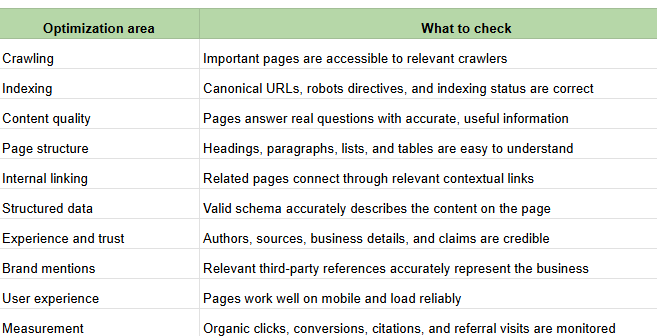
Prioritize errors that prevent discovery or undermine the usefulness of a page before spending time on cosmetic optimization.
What Schema Markup Helps with AI Search?
Schema markup is structured data that helps search engines interpret information about a page, organization, product, article, or other entity.
It can support search understanding and eligibility for certain search features, but schema markup does not guarantee inclusion in AI Overviews or ChatGPT answers.
The appropriate schema depends on the content.
Organization schema
Organization structured data can help describe a company, including its name, official website, and other supported identifying details.
Use accurate information that matches the visible content and the business's real-world identity.
Article schema
Article or BlogPosting markup can describe an article's headline, author, publication date, and other relevant properties.
This can help search engines interpret the page's publishing information. It is not a shortcut to AI citations.
LocalBusiness schema
For eligible local businesses, appropriate LocalBusiness markup can communicate details such as the business name, address, contact information, and opening hours.
Use the specific subtype and properties that accurately describe the business. A service-area business should not invent a physical address to populate a schema field.
Product and Service information
Use supported structured data types where appropriate for products, offers, or other eligible content. For service pages, ensure that the actual services, locations, and business details are clearly described on the page.
Do not create fake ratings, fabricated reviews, or unsupported prices in structured data.
FAQ content and FAQ schema
FAQs can make an article more useful by answering specific questions that readers commonly ask.
However, publishing FAQ content does not mean Google will display an FAQ rich result, and FAQ schema is not a guaranteed AI ranking signal. Google's eligibility and display rules for search features can change.
The best reason to include FAQs is to address genuine information needs, not simply to add more keywords.
After implementation, validate structured data with Google's Rich Results Test where applicable and review relevant Search Console reports.
How to Format FAQs for AI Search
FAQ sections work best when they provide concise, complete answers and then add detail where needed.
For example:
Question: Is SEO still worth it in 2026?
Answer: Yes, SEO can still be valuable in 2026 because people continue to use search engines to discover businesses, research solutions, and compare products. AI-powered search changes how some results are presented, but it does not remove the need for discoverable, useful, trustworthy website content.
This answer is direct without suggesting that every business will achieve the same results.
Follow these principles when writing FAQs:
- Use questions that reflect real user concerns.
- Answer the question immediately in the first sentence or two.
- Add supporting context, examples, or limitations.
- Avoid repeating the same answer under slightly different questions.
- Use plain language and explain technical terminology.
- Link to a more detailed resource when readers need additional information.
Do not create dozens of nearly identical FAQs just to target keyword variations. A smaller collection of useful answers is often better for the reader.
What Is AEO in Real Estate Marketing?
Answer Engine Optimization in real estate marketing means making a property business's information easier for people and answer-focused search systems to find, understand, and evaluate.
Real estate searches are often highly specific. A prospective buyer may ask about property prices in Noida, residential projects near a metro station, commercial property in Gurgaon, or the documents required to purchase a home.
A real estate website should provide accurate and helpful answers to these questions.
Can a local real estate agent compete with Zillow in AI search?
A local real estate agent can build visibility for relevant local queries by providing accurate neighbourhood knowledge, genuine property information, local expertise, and useful guidance.
Competing with a large property portal for every broad search is unrealistic for many independent agents. However, a local business may have a meaningful opportunity to serve specific searches that require detailed knowledge of a neighbourhood, property type, buyer concern, or local market.
For example, instead of publishing another generic article about buying a house, an agent might create a useful guide to evaluating residential properties in Indirapuram, including verified local considerations, commuting options, questions to ask during a viewing, and relevant buying costs.
Such content should be accurate, regularly reviewed, and transparent about its limitations. Do not present general neighbourhood commentary as verified property data.
How can a real estate agent improve AI search visibility?
A practical strategy includes:
- Maintaining an accurate Google Business Profile where eligible.
- Publishing original neighbourhood and property guides.
- Creating genuinely distinct location pages.
- Keeping listings and contact details current.
- Encouraging authentic customer reviews without incentives that violate platform policies.
- Earning relevant mentions from local publications and property-related organizations.
- Adding appropriate structured data.
- Making important property details available in accessible text.
- Tracking organic enquiries and qualified leads.
A local agent does not need to imitate a national portal. The goal is to provide useful information for the particular customers and locations the business serves.
For businesses looking to connect search visibility with enquiries, Adwizly also provides real estate SEO services focused on location-specific searches, property pages, technical SEO, and organic visibility.
How should real estate FAQs be structured?
Real estate FAQs should address practical questions that buyers, sellers, renters, or investors genuinely need answered.
Examples include:
- What should buyers check before purchasing a residential property?
- Which documents should be reviewed before a property transaction?
- What factors influence property prices in a particular neighbourhood?
- How can buyers compare two residential projects?
- What questions should a buyer ask a real estate agent?
Answers should distinguish general educational guidance from legal, financial, and transaction-specific advice. Where requirements vary by state or property, say so and direct readers to appropriate official sources.
What schema markup should a real estate website use?
Depending on the page, relevant structured data may include Organization, LocalBusiness, BreadcrumbList, Article, or other supported types that accurately describe the content.
Use property-specific structured data only where the relevant type is supported and the information genuinely applies. Do not assume that Google or ChatGPT uses a particular property schema as a special ranking signal.
How Does Google Business Profile Affect AI Search Visibility?
A well-maintained Google Business Profile can help eligible local businesses present accurate information in Google Search and Maps.
Keep your business name, address or service area, phone number, website, categories, opening hours, and other relevant details accurate. Add genuine photos, respond professionally to reviews, and keep important information current.
These practices support local discovery and help customers evaluate a business.
However, a Google Business Profile does not guarantee that a company will appear in a Google AI Overview or be recommended by ChatGPT. Different platforms may retrieve and evaluate information through different systems and sources.
Businesses should maintain their profiles because accurate local information benefits customers, not because any single profile guarantees AI visibility.
Do Reviews and Third-Party Mentions Matter for AI Search?
Reviews and third-party mentions can help people assess a business's credibility, experience, and reputation.
For example, someone comparing two marketing agencies might look at case studies, customer reviews, industry articles, company websites, and professional profiles before deciding whom to contact.
A credible online presence can make a business easier to verify and may contribute to the information available to search systems. The exact influence of individual review platforms on AI recommendations is not fully transparent and can differ between systems.
To build a stronger reputation:
- Ask genuine customers for honest feedback.
- Respond to criticism professionally.
- Keep business profiles accurate.
- Contribute useful expert commentary to relevant publications.
- Publish original case studies with appropriate permissions.
- Correct inaccurate third-party information where possible.
Avoid fabricated testimonials, review manipulation, and paid editorial links disguised as independent recommendations.
Does YouTube Help You Rank in AI Search?
YouTube can support an AI search strategy by making useful video content available to people researching your subject.
Videos can explain complex topics, demonstrate products, answer common questions, and introduce the people behind a business. Depending on the query and platform, video content may also be surfaced in search experiences.
For example, an SEO agency could publish a tutorial on improving technical SEO, a walkthrough of a real estate landing page, or a discussion of common mistakes in EdTech marketing.
To improve discoverability:
- Choose a descriptive, accurate video title.
- Explain the topic clearly in the description.
- Structure the video around a specific user need.
- Use captions and review their accuracy.
- Publish a useful supporting article when it adds value.
- Embed the video on a relevant page where appropriate.
- Avoid misleading thumbnails, titles, or claims.
A YouTube channel is not a guaranteed ranking factor for AI-generated answers. Its value lies in providing another useful way for people to discover and understand your expertise.
Is SEO Still Worth It in 2026?
Yes. SEO can remain a valuable acquisition channel in 2026, but businesses should evaluate it by the quality of the visibility and outcomes it produces rather than by rankings alone.
AI-generated summaries can answer some questions without a website visit. At the same time, people may still click through to verify information, compare providers, explore products, read detailed guides, or contact a business.
This means SEO strategy should account for both direct website traffic and the broader role of organic discovery.
A modern SEO strategy should focus on:
- Relevant search visibility.
- Helpful, original content.
- Strong technical foundations.
- Credibility and expertise.
- Conversion-focused landing pages.
- Brand discovery across relevant platforms.
- Qualified leads, enquiries, and revenue.
Not every business will see the same results. Outcomes depend on competition, search demand, website quality, the offering, and how effectively organic visitors become customers.
The objective is not to abandon traditional SEO. It is to adapt it to a search environment in which conventional results, AI summaries, and conversational discovery can coexist.
How to Track AI Search Traffic in Google Analytics 4
Measuring AI search performance requires more than checking whether a website received traffic from an AI platform.
Use a combination of referral analytics, search performance data, conversion tracking, and repeatable visibility checks.
1. Review referral traffic
In Google Analytics 4, open the Reports section and examine traffic acquisition data. Look at the session source and medium dimensions to identify visits attributed to AI platforms when their referral information is available.
Depending on how traffic is recorded, you may see sources such as chatgpt.com or perplexity.ai. The exact source values can vary.
Filter the report by the relevant source, then compare sessions, engaged sessions, key events, and conversions.
Not every AI-assisted visit will be identifiable. Users may discover a brand in an AI answer and later navigate directly to the website, search for the brand on Google, or visit through another channel.
2. Monitor Google Search Console
Use Search Console to track impressions, clicks, click-through rate, average position, query-level performance, and indexing status for Google Search.
Google's guide to optimizing for generative AI features also describes how to measure performance through the Generative AI performance report in Search Console, where available to your property.
These reports help you evaluate search visibility and diagnose technical issues. They should not be treated as a complete report of citations inside every AI platform.
3. Track meaningful conversions
Set up appropriate key events in GA4, such as:
- Contact form submissions.
- Qualified enquiry requests.
- Clicks on business contact details.
- Consultation bookings.
- Relevant sign-ups or purchases.
For a real estate agency, the most important outcome may be a qualified property enquiry rather than a high number of page views.
For an EdTech company, it might be a course enquiry, counselling booking, or completed application.
Connect organic discovery to business outcomes wherever the available data allows.
4. Build a repeatable AI visibility test
Create a consistent set of relevant questions and test them periodically across the platforms that matter to your audience.
Record:
- The date and exact query.
- Whether the brand appeared.
- Whether the website was cited or linked.
- Which competing sources appeared.
- The landing page associated with any citation.
- Any resulting referral traffic or enquiries that can be attributed.
Keep in mind that generated answers can change. A test is a snapshot, not a definitive ranking report.
5. Use a combined measurement framework
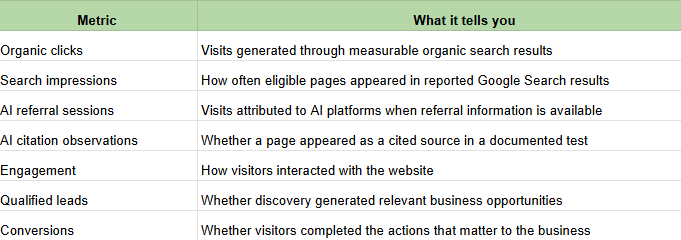
Do not judge an AI search campaign by citations alone. A citation with no relevant audience may be less valuable than a smaller number of visits that produce qualified enquiries.
Common AI SEO Mistakes to Avoid
As AI search becomes more prominent, businesses may be tempted to adopt tactics that promise fast visibility. Several practices can undermine long-term performance.
Publishing large volumes of generic AI-generated content: Content created primarily to manipulate rankings, without meaningful value or editorial oversight, can fail to meet Google's quality expectations.
Stuffing every section with keywords: Repeating phrases such as "best AEO agency" or "AI SEO services" unnaturally makes content harder to read and does not guarantee better visibility.
Assuming schema guarantees citations: Structured data can help systems interpret information, but it does not guarantee inclusion in generated answers.
Buying large quantities of backlinks: Irrelevant or manipulative links can create risks without providing genuine authority or referral value.
Creating duplicate location pages: Replacing only the city name across dozens of pages does not provide the local information customers need.
Blocking important crawlers accidentally: Incorrect robots.txt rules, firewall settings, or indexing directives can prevent relevant systems from accessing important pages.
Ignoring conversion quality: More impressions or referral visits do not automatically mean more customers.
A sustainable AI search strategy focuses on information quality, technical accessibility, credibility, and measurable business value.
A 30-Day AI Search Optimization Plan
Businesses can begin improving their AI search readiness through a structured, realistic plan.
Week 1: Audit your website
Review your important pages, indexing status, canonical tags, robots.txt, sitemap, internal links, mobile usability, and structured data.
Identify the pages that matter most to your business and resolve critical accessibility or technical issues first.
Week 2: Improve existing content
Select a small group of high-priority pages. Improve their answers to user questions, remove outdated information, add original insights, strengthen headings, and include useful supporting evidence.
Add FAQs where they genuinely help the reader rather than simply increasing page length.
Week 3: Strengthen credibility and topical coverage
Update author information, improve relevant company profiles, add genuine case studies, and identify related articles that should link together.
Look for legitimate editorial opportunities and industry publications where your expertise would benefit readers.
Week 4: Measure and refine
Review Search Console and GA4 data, test a consistent set of AI search queries, and record any observed citations or referral visits.
Identify which pages need further work based on the evidence. Use the findings to plan the next month rather than expecting a guaranteed result within 30 days.
AI search visibility can change unpredictably, and the time required to see measurable results depends on the site's existing condition, competition, content quality, and platform behaviour.
Frequently Asked Questions About AEO, GEO, and AI Search
How do I rank in AEO?
Improve the clarity, relevance, accuracy, and accessibility of your content. Answer specific questions directly, organize pages with descriptive headings, provide supporting evidence, and maintain a technically sound website. Monitor actual search and citation outcomes rather than relying on a single AEO ranking score.
How do I get listed in Google AI Overviews?
There is no application or guaranteed placement method for Google AI Overviews. Follow Google's Search Essentials, create helpful and reliable content, ensure important pages can be crawled and indexed, and build relevant pages that answer users' questions. Inclusion depends on Google's systems and the query.
Can I do SEO myself?
Yes. Website owners can handle many SEO fundamentals themselves, including keyword research, writing useful content, improving titles and headings, adding internal links, checking Search Console, and updating business information. More complex technical problems or highly competitive campaigns may require specialist support.
How fast is AI search replacing traditional search?
AI search is changing how people discover information, but it is not accurate to say that it has completely replaced traditional search. The balance varies by query, audience, market, and platform. Businesses should monitor how their own customers search instead of assuming that every industry is changing at the same pace.
Does ChatGPT use Google or Bing to find local businesses?
Do not assume that ChatGPT Search relies exclusively on either Google or Bing. ChatGPT Search uses its own search and retrieval experience and may draw on web sources through its search infrastructure. The precise sources and systems used for a particular response can vary.
Which third-party review sites influence ChatGPT recommendations?
There is no universal, publicly confirmed list of review websites that determines ChatGPT recommendations. Relevant business listings, reviews, and independent publications may contribute useful information, but their influence depends on the query and retrieval process. Focus on genuine reviews and accurate business information across relevant platforms.
How do I measure visibility in ChatGPT Deep Research?
Use repeatable prompts relevant to your audience and document whether your brand or pages are mentioned, which sources are cited, and whether the findings change over time. Combine these observations with measurable referral visits and conversions. Do not treat a limited set of tests as a complete measure of platform-wide visibility.
Do AI search engines generate clicks for businesses, or is everything zero-click?
AI search can produce both zero-click answers and website visits. Some users get enough information from a generated response, while others click through to verify details, read a full guide, compare providers, or make a purchase. The balance varies by query and platform, so businesses should measure the outcomes available to them.
What is the difference between AEO and GEO?
AEO focuses on making information useful and accessible for direct answers. GEO focuses on improving a brand's visibility and representation in generative AI responses. Both overlap with SEO and benefit from helpful content, technical accessibility, and credible information.
Does publishing more content improve AI search rankings?
Not automatically. Publishing additional pages can expand useful topic coverage, but only when the pages satisfy distinct user needs and provide meaningful value. A smaller set of strong, well-maintained resources may be more useful than hundreds of repetitive articles.
Final Thoughts: Build for People First, Then Optimize for AI Search
AI search optimization is not a replacement for SEO. It is an extension of the work required to make a website useful, accessible, credible, and easy to understand.
Businesses that want to improve their chances of appearing in ChatGPT Search and Google AI Overviews should focus on the fundamentals: helpful content, accurate information, strong technical SEO, relevant internal links, credible third-party references, and consistent measurement.
For local businesses and real estate companies, this also means answering location-specific questions, maintaining accurate business information, publishing original expertise, and earning the trust of the communities they serve.
There is no guaranteed shortcut to AI visibility. The more sustainable approach is to build a website that genuinely deserves to be discovered, referenced, and visited.
Want to strengthen your website's search visibility? Explore Adwizly's SEO services to learn how a structured approach to technical SEO, content optimization, and organic growth can support your digital marketing goals.
To learn more about the team and its approach to digital growth, visit About Adwizly.