

Best SEO Services for Real Estate in India: Cost, Timeline and How to Choose
A complete guide for developers and brokers: what real estate SEO includes, what it costs in India, how long it takes, RERA rules and AI search readiness.
By Utkarsh Singh, SEO Executive · Updated October 2026
Quick answer:The best SEO services for real estate in India are the ones built around how property buyers actually search: project pages, locality pages, configuration pages and a strong Google Business Profile, all tracked down to enquiries and site visits, not just rankings. Look for real estate experience, RERA-aware content, honest timelines and reports you can verify yourself.
Key takeaways
- Real estate SEO runs on project, locality and configuration pages, plus a verified Google Business Profile.
- Judge providers on site-visit tracking, account ownership and honest claims, not on promised rankings.
- Published guides put competitive real estate SEO near ₹40,000 to ₹90,000 or more a month, with early gains in three to six months.
- RERA applies to web pages: register first, show the number and keep every claim accurate.
- AI search rewards clear, consistent, quotable facts, so publish project fact sheets and test your visibility monthly.
On this page
- What do real estate SEO services include?
- How should you judge "best"?
- Which type of provider is right for you?
- How much does real estate SEO cost in India?
- How long does real estate SEO take?
- What's the best site structure for real estate SEO?
- Why does Google Business Profile matter for real estate?
- What RERA rules apply to your web pages?
- How do you prepare your projects for AI search?
- How should developers and brokers approach SEO differently?
- Which metrics should you track?
- What are the red flags when hiring?
- Is there a local advantage in NCR and Agra?
- Which questions should you ask before hiring?
- How does SEO work alongside paid marketing?
- How Adwizly approaches real estate SEO
- Real estate SEO glossary
- Sources and notes
- FAQs
If you've spent any time comparing real estate SEO providers, you've probably noticed the pattern. Every page promises page-one rankings. Almost none tell you what the work involves, what it costs, how long it takes or what a good report looks like.
This guide fills those gaps. It explains what real estate SEO services include, how to compare providers without relying on a self-published "top 10" list, what you can realistically expect to pay in India and what a sensible timeline looks like. It also covers RERA rules for web pages and how to prepare for AI search, which is changing how buyers find projects.
We're Adwizly, a digital growth agency that works with real estate and EdTech brands, so we do offer this service. We'll say where it fits near the end, and keep the rest useful whether or not you ever speak to us.
What do real estate SEO services include?
Real estate SEO services cover the work that makes your projects easy to find and trust in search: technical fixes, project, locality and configuration pages, Google Business Profile management, content, links, structured data and, increasingly, optimisation for AI-generated answers. The goal is qualified enquiries and site visits, not just higher rankings.
Here's what that looks like in practice:
Key SEO Services for Real Estate Projects.
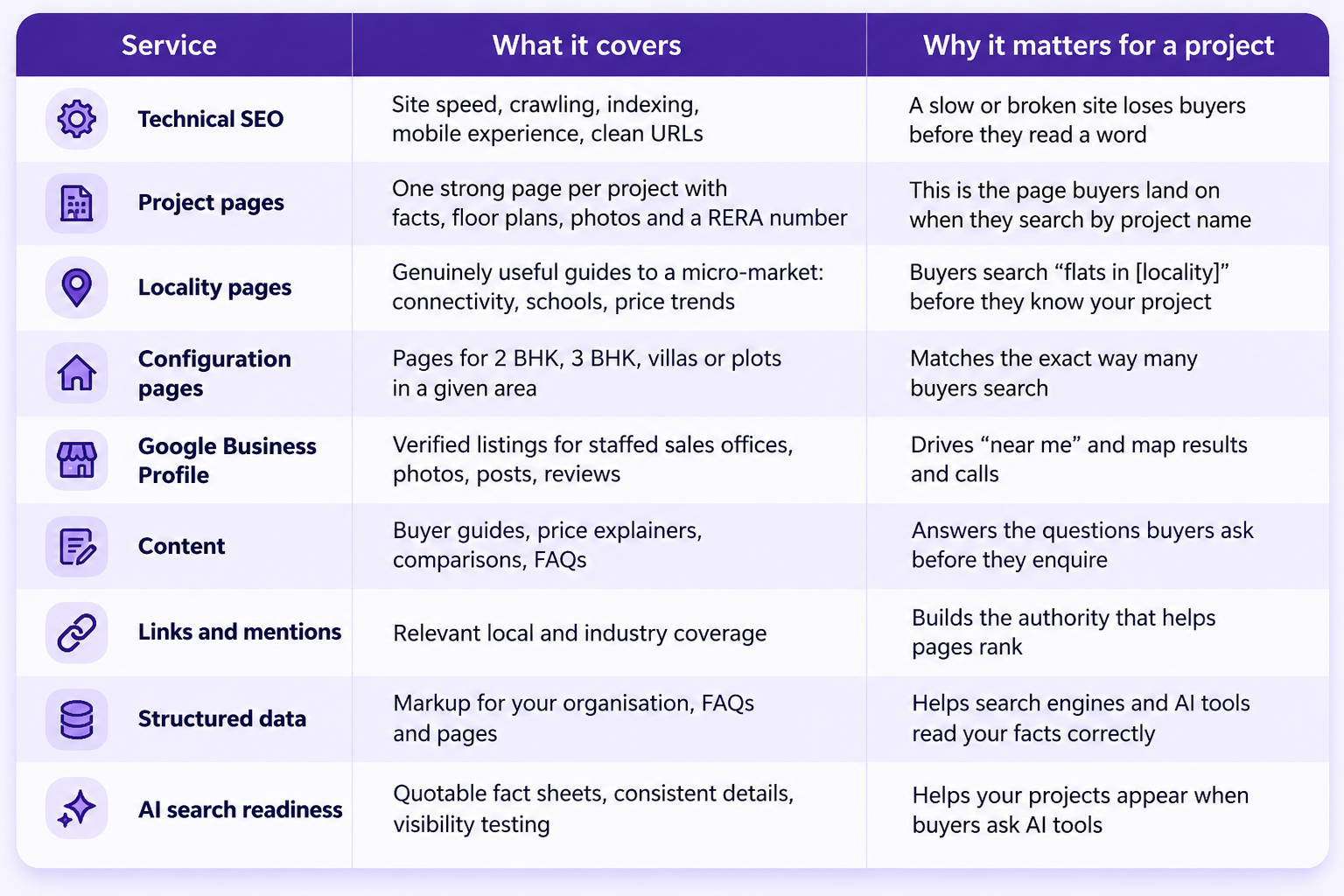
Each service plays a different role in helping property projects get discovered online, from improving website crawlability and targeting location-specific searches to building trust and making project information easier for search engines and AI tools to understand.
If you want this handled for you, our real estate SEO services cover each of these areas.
How should you judge "best"?
Nobody neutral publishes a ranking of real estate SEO companies, and lists that rank their own publisher first aren't evidence. A more useful approach is to score each provider you're considering against the same criteria. Here's the scorecard we'd use if we were buying.
- Real estate focus. Can they explain project, locality and configuration pages without you prompting them?
- Lead and site visit tracking. Do they report on enquiries, qualified leads and site visits, or only on traffic and rankings?
- Page planning. Do they plan locality pages around real buyer demand, or mass-produce thin city pages?
- Ownership. Will you own your Search Console, Analytics, Google Business Profile and website at all times?
- AI search readiness. Do they have a method for testing how your projects appear in AI answers, or just a claim?
- Honest claims. Do they avoid guaranteed rankings, "assured" results and unverifiable awards?
- Compliance. Do they understand RERA rules for web pages?
- Transparency. Is pricing explained, and can you see what you get for it?
Give each a score out of five. The total matters less than the lowest score. A provider who fails on ownership or honesty is a risk, however good the rest looks.
Which type of provider is right for you?
The right real estate SEO provider depends on your budget, business size and growth goals. A freelancer may be enough for a local broker or a single property project, while developers operating in competitive markets may benefit from a specialist agency. If you also need paid advertising, social media marketing and lead management, a full-funnel marketing agency may be a better fit.
The table below compares the main provider types, their typical monthly costs and the key factors to consider before choosing one.
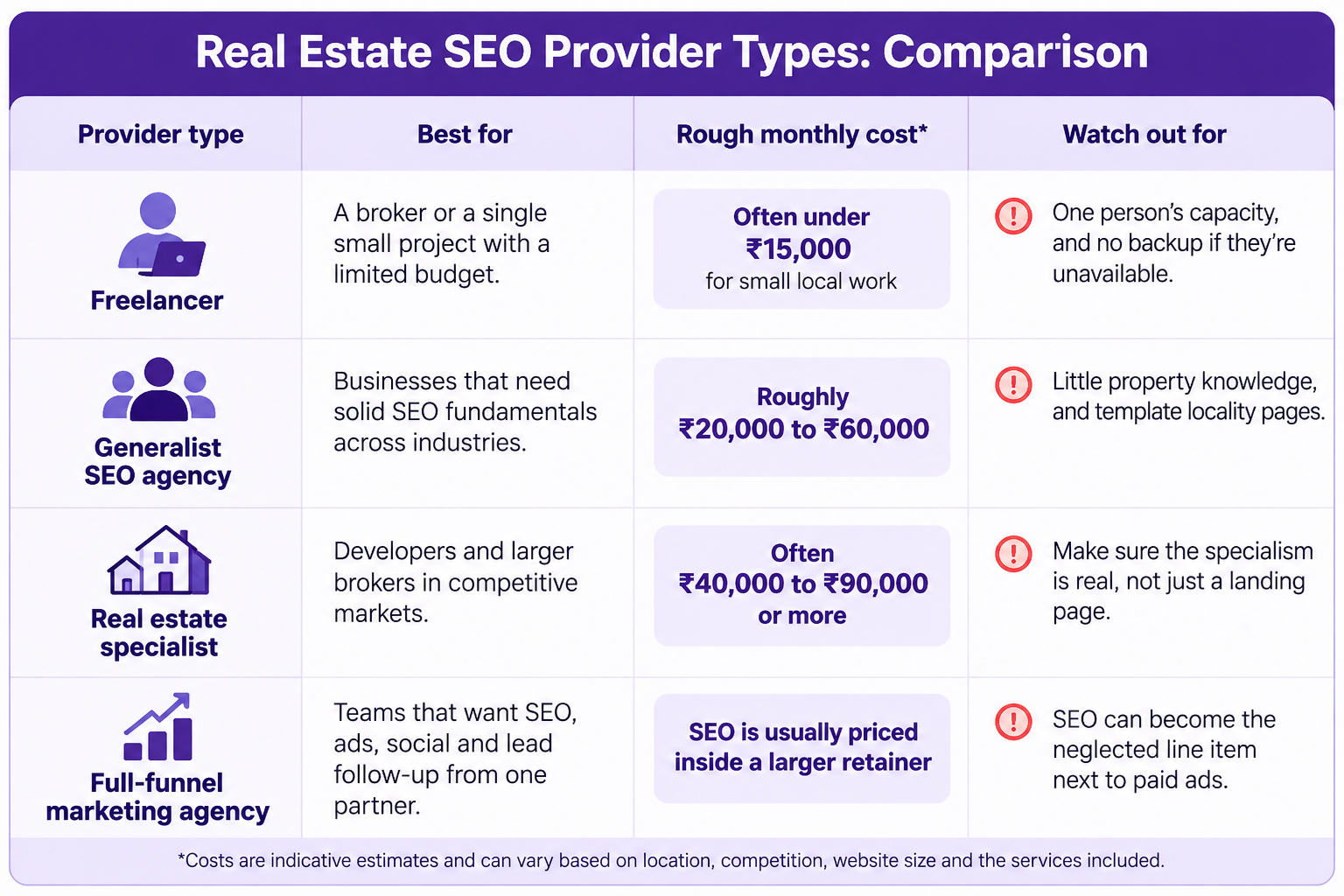
*These are indicative figures drawn from published pricing guides, not quotes. Always ask for a written proposal.
No type is automatically best. A good freelancer will often beat a poor specialist. What matters is whether the person doing the work understands property buyers and can prove it.
When comparing providers, look beyond the monthly fee. Ask for relevant real estate SEO case studies, a clear scope of work, reporting on qualified enquiries and site visits, and a strategy tailored to your target locations. Check whether technical SEO, content creation, link building and local SEO are included in the quoted price.
The costs shown above are indicative estimates, not fixed market rates. Actual pricing varies by location, competition, website size and the services included. Before signing a contract, confirm the deliverables, reporting frequency and how success will be measured.
How much does real estate SEO cost in India?
Real estate SEO in India usually costs somewhere between a few thousand rupees a month for basic local work and several lakh for large, multi-city programmes. For competitive property markets, published agency pricing guides most often land around ₹40,000 to ₹90,000 or more a month. Your actual cost depends on how many projects, localities and pages you need.
Published guides from Indian agencies, such as upGrowth and Prateeksha, suggest broad bands like these. They come from agencies' own marketing pages, so treat them as indicative, not as a price list:
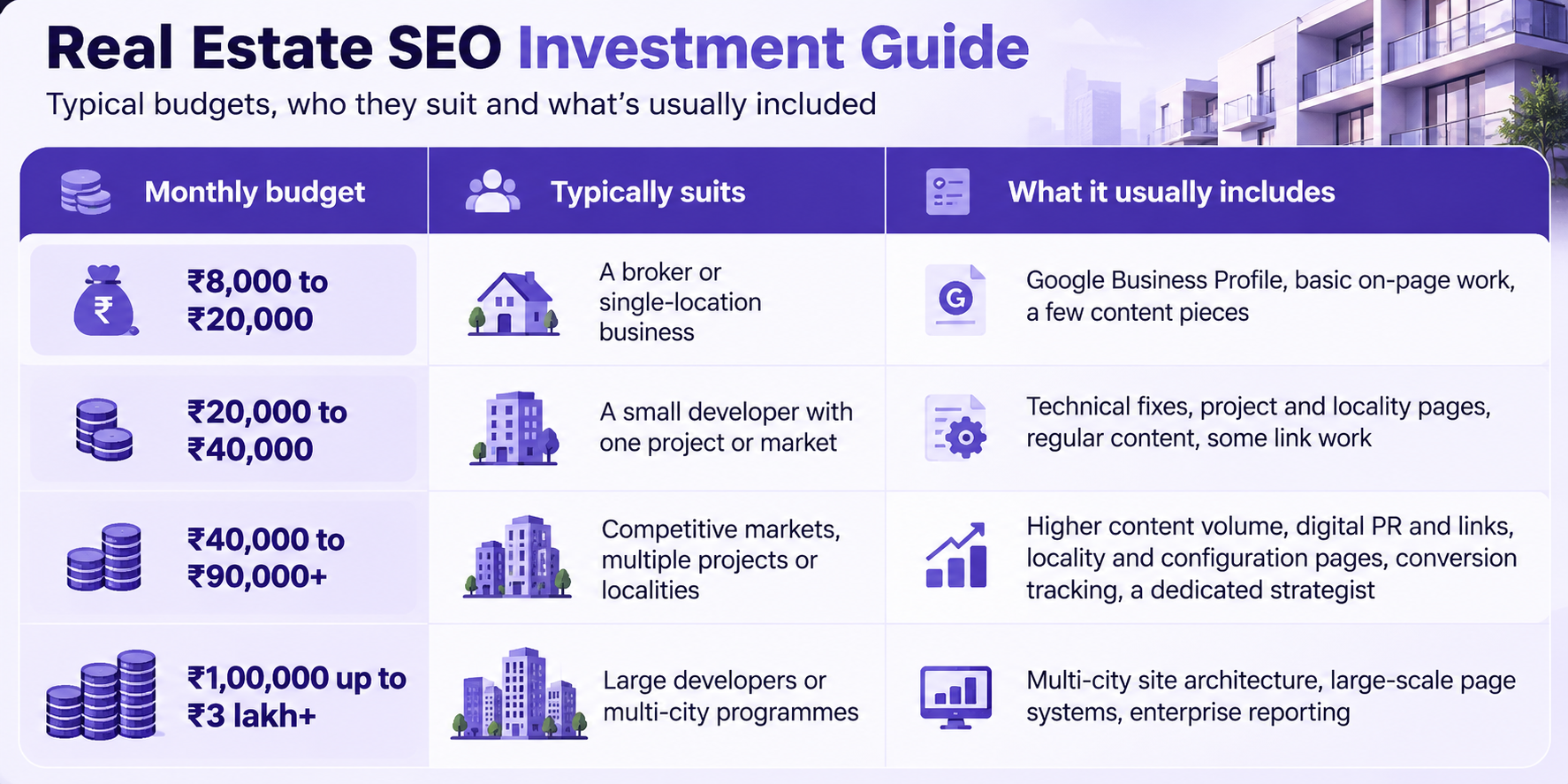
The right real estate SEO budget depends on your market competition, number of property projects, target locations and business goals. Smaller brokers may start with basic local SEO, while developers competing across multiple locations often need a broader strategy covering technical SEO, project pages, content marketing, link building and conversion tracking.
Before choosing an SEO package, confirm exactly what is included, how frequently you'll receive reports, and how performance will be measured. Focus on qualified property enquiries, relevant organic traffic and site visits rather than rankings alone.
Note: The monthly budgets above are indicative estimates, not fixed market rates. Actual pricing varies by agency, scope of work and competition.
What drives the price up or down
- Number of projects. Each needs its own strong page and content.
- Number of localities. Every micro-market you want to rank in needs real, useful pages.
- Competition. "Flats in Noida" is far harder than a niche, specific search.
- Site condition. A slow or messy site needs fixing before anything else works.
- Content volume and quality. Original, expert-reviewed content costs more than filler.
- Link and PR work. Genuine mentions take time and effort.
- Reporting depth. Tracking down to site visits takes more setup than reporting rankings.
Be careful with very low prices
A quote of ₹3,000 to ₹5,000 a month for "full SEO" usually means automated links, copied content or very little work. Fixing a penalty later often costs more than good SEO would have in the first place. A more useful comparison is cost per outcome, such as cost per qualified enquiry or site visit over twelve months, not the monthly fee on its own.
How long does real estate SEO take?
Most real estate SEO programmes take three to six months to show early gains and six to twelve months to build lasting growth. Nobody can promise exact dates, because results depend on competition, your site's starting point and how quickly pages can be published. Here's a realistic way to think about it.
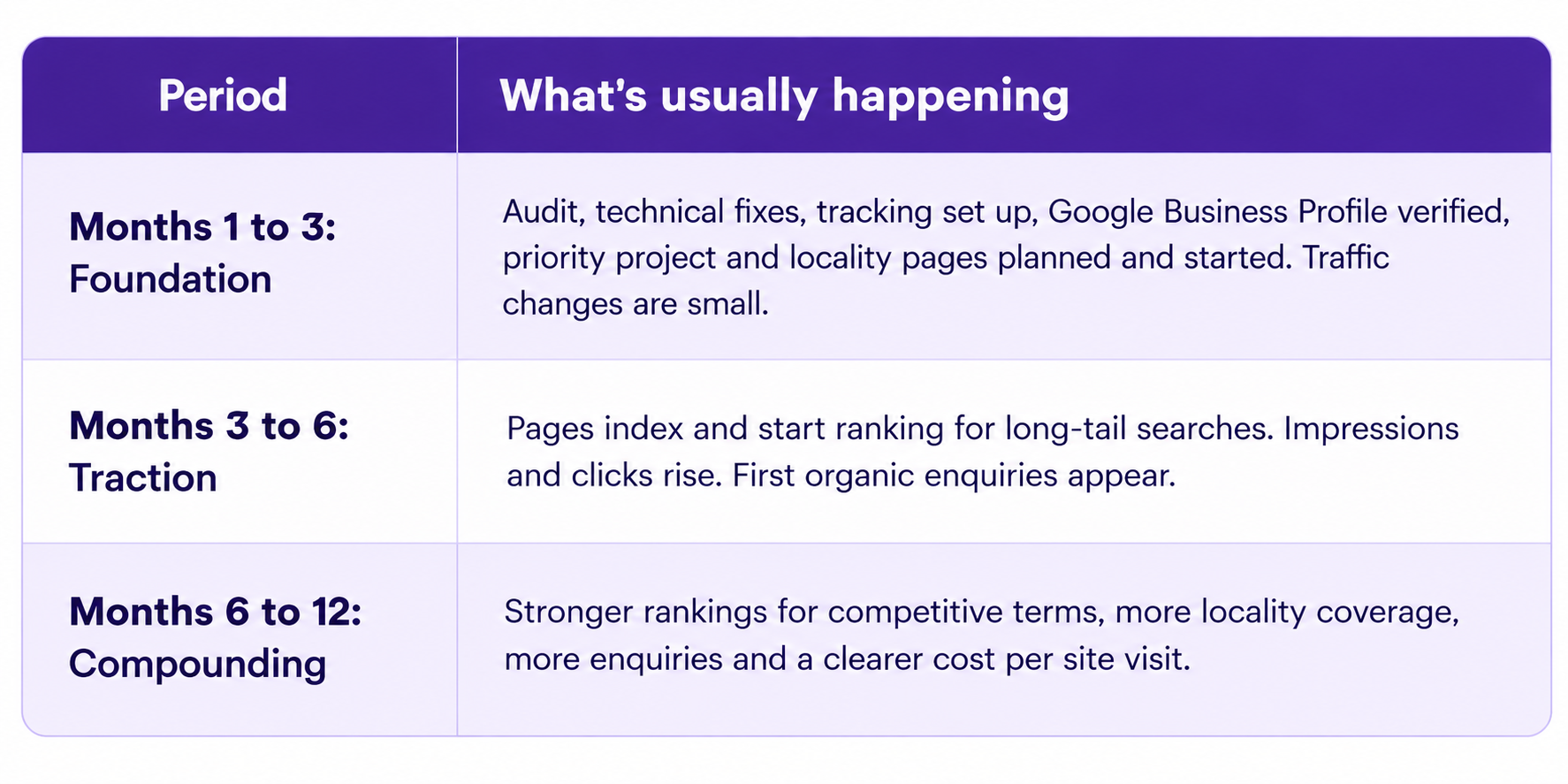
If a provider promises page one in thirty days for a competitive search, treat it as a warning sign.
SEO results vary depending on your website's current condition, competition, target locations and the quality of implementation. During the first few months, the focus is usually on fixing technical issues, improving key project pages and building a strong foundation. As search engines discover and index these improvements, organic impressions, rankings and enquiries may begin to grow.
To measure progress, track Google Search Console impressions and clicks, keyword rankings, organic website traffic and qualified property enquiries. Review these metrics monthly and adjust your strategy based on what is working.
Remember, SEO is a long-term investment. Consistent improvements and realistic expectations are more valuable than promises of instant rankings.
What's the best site structure for real estate SEO?
The best structure for most developers and brokers is a clear hierarchy: home page, then city, locality, project and configuration pages, each linked to the next. This helps buyers move from a broad search to a specific unit, and helps search engines understand how your pages relate to one another.
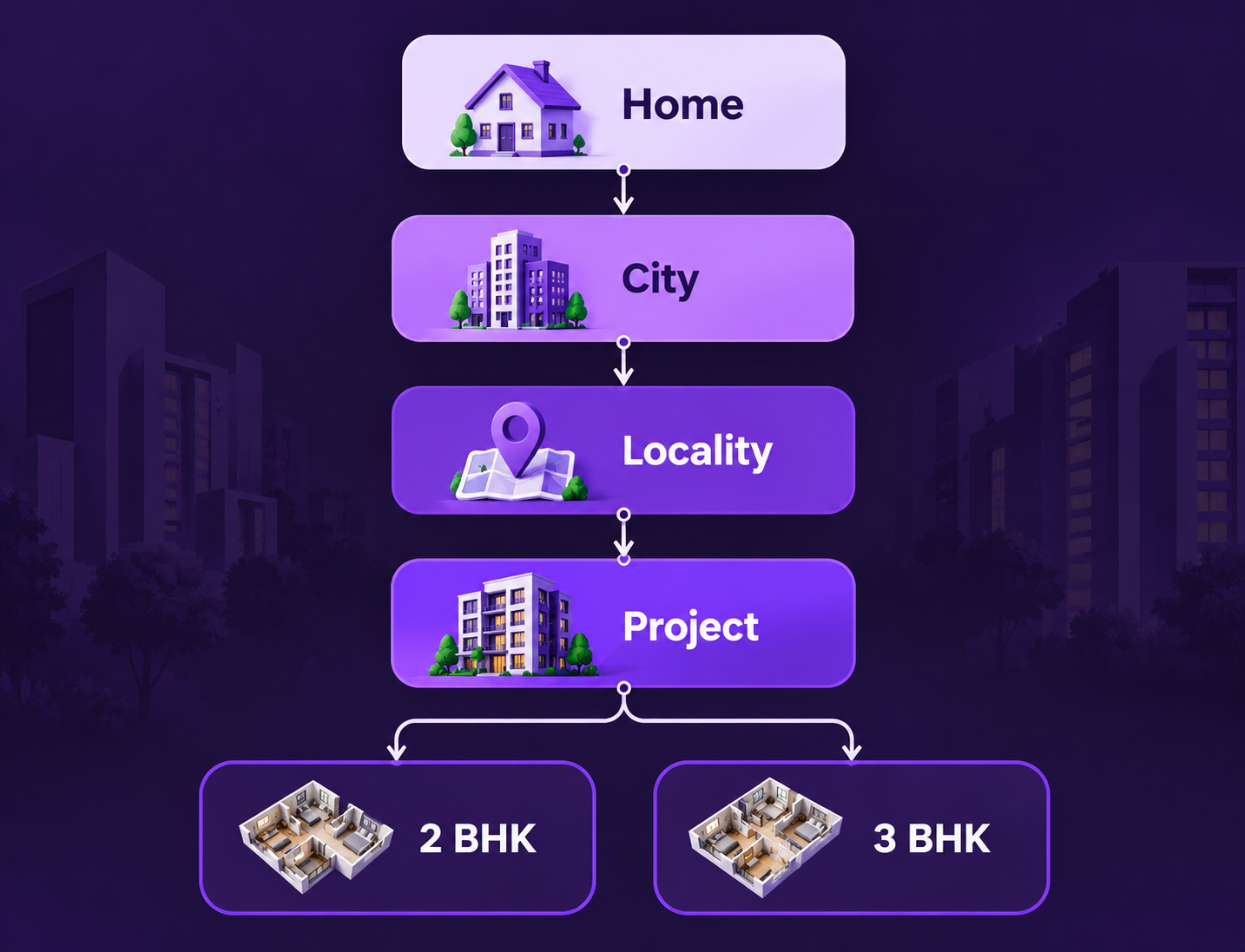
A few rules that keep it healthy:
- Make each page genuinely different. A city page that only swaps the city name is a doorway page. It adds nothing and can hurt you.
- Build locality pages around real demand. Cover connectivity, schools, hospitals, price trends and upcoming infrastructure that buyers care about.
- Link both ways. The project page should link up to its locality, and the locality page down to its projects.
- Handle sold-out projects carefully. Don't delete the page. Mark the project as sold out, keep the useful information and link to similar available projects. If a page has no value left, redirect it to the closest relevant page.
Why does Google Business Profile matter for real estate?
Google Business Profile helps buyers find your sales gallery or office in map results and "near me" searches, and it can drive calls and direction requests directly. For real estate, it's one of the fastest ways to gain local visibility, as long as the listing is eligible, accurate and actively managed.
- List staffed sales offices that customers can visit. Google expects a real, staffed location, not an empty plot or a virtual address.
- Keep your name, address and phone number identical on your website and every listing.
- Add real photos of the sales gallery, the model flat and the site.
- Ask genuine customers for reviews, and reply to them.
- Post updates such as launches, offers and possession progress.
What RERA rules apply to your web pages?
RERA rules apply to online marketing as much as to print. Under the Real Estate (Regulation and Development) Act, 2016, a promoter generally can't advertise or market a project before registering it, and the project's registration number must appear on advertisements and on the website. State authorities may add their own requirements, so check yours.
Use this as a working checklist, and confirm the details with your legal adviser and state RERA authority:
- Don't publish promotional pages before the project is registered. Section 3 covers advertising, marketing and inviting buyers.
- Show the RERA registration number on project pages and in your ads. Some state authorities also expect the authority's website address.
- Keep every claim accurate. Section 12 of the Act deals with false or misleading statements, so avoid unverifiable promises about returns or appreciation.
- Keep facts up to date, including possession dates, approvals and availability.
- Keep brochures and creatives consistent with what you've registered.
- Remember that "advertisement" is broad. Regulators have treated social media posts as advertisements too.
How do you prepare your projects for AI search?
AI tools such as Google's AI Overviews and AI Mode, ChatGPT, Gemini and Perplexity increasingly answer buyer questions directly. To appear in those answers, make your facts clear, consistent and easy to quote, and keep earning the trust that traditional SEO builds. Nobody can guarantee a citation, but you can improve your odds and test them.
Make your facts quotable
- Publish a clear fact sheet for every project: location, configurations, sizes, possession date, developer, RERA number and a price starting point with the date it applies.
- Use the same details everywhere: website, Google Business Profile, listings and press.
- Answer real buyer questions in plain language, with a short direct answer first.
- Add structured data so machines can read your organisation, FAQs and pages.
- Show who wrote and checked your content.
A simple test you can run every month
- Write ten questions a buyer might ask, such as "best 3 BHK projects in [locality]" or "is [project name] RERA registered?"
- Ask each one in Google (including AI Overviews or AI Mode where they appear), ChatGPT, Gemini and Perplexity.
- Record whether your project or brand is mentioned, whether you're cited and whether the facts are correct.
- Take screenshots and note the date.
- Fix wrong or missing facts on your own pages, then test again next month.
Keep the results in a sheet. After a few months, you'll see whether you're gaining visibility.
How should developers and brokers approach SEO differently?
Developers and brokers need different plans because they sell different things. Developers promote specific projects with limited inventory, while brokers sell many listings across localities and compete on trust and local knowledge. So developers should prioritise project and RERA-compliant pages, while brokers should prioritise Google Business Profile, reviews and local content.
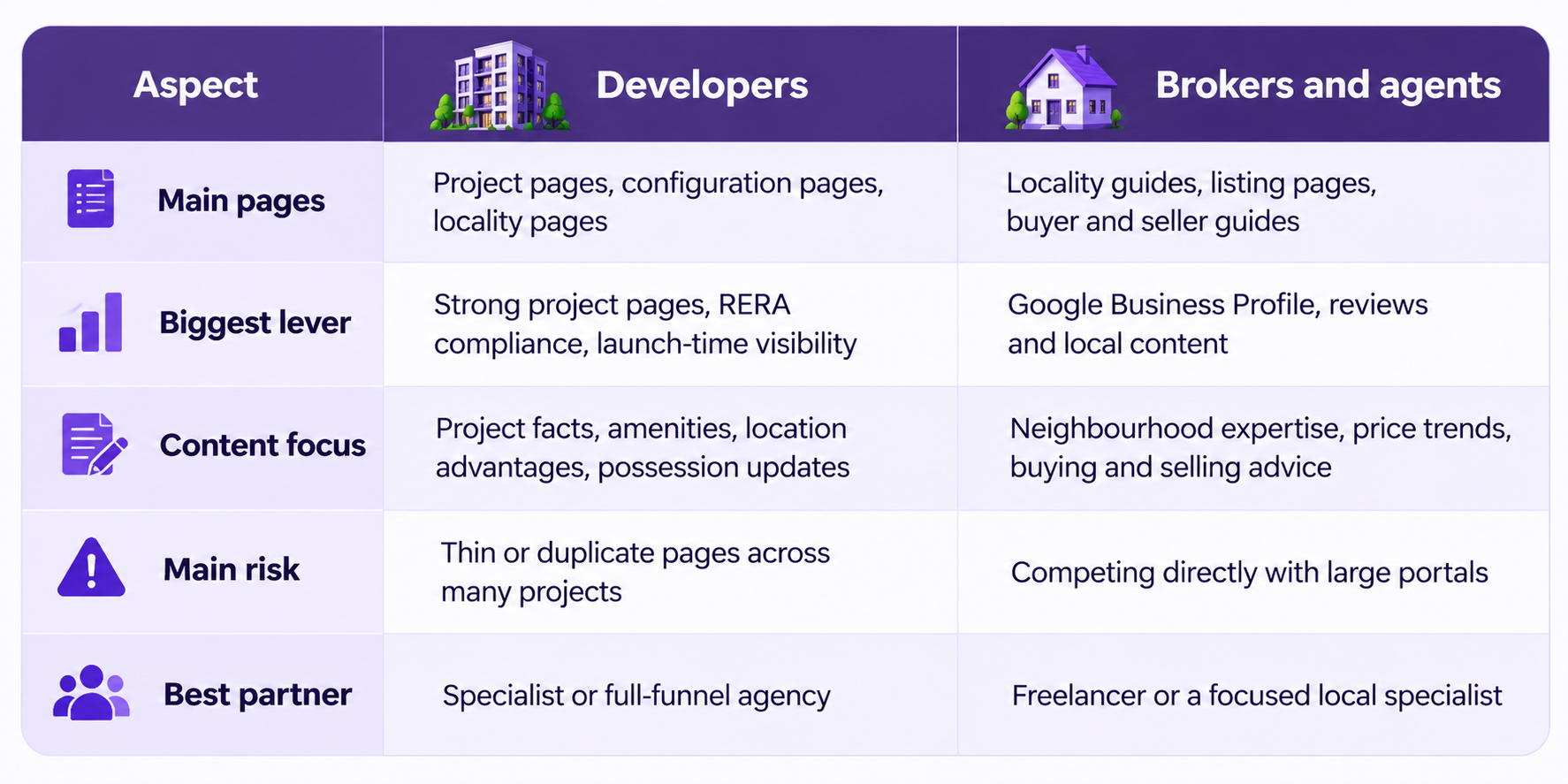
Choosing the right SEO strategy starts with understanding your business model. Real estate developers should focus on project-specific pages, accurate property information, launch visibility and location-based searches. Brokers and agents can gain an advantage by building local authority through Google Business Profile optimisation, genuine customer reviews, neighbourhood guides and helpful buying advice.
Regardless of your business type, avoid duplicate content and generic location pages. Create useful, original information for each target market, track qualified enquiries and regularly review your organic search performance. The right approach should support your business goals, not just increase website traffic.
Which metrics should you track?
Track the metrics that follow a buyer from search to site visit: organic enquiries, qualified lead rate, site visits and cost per site visit, supported by Search Console impressions, Google Business Profile activity and rankings. Rankings alone tell you little. Ask your provider for this set in every report.
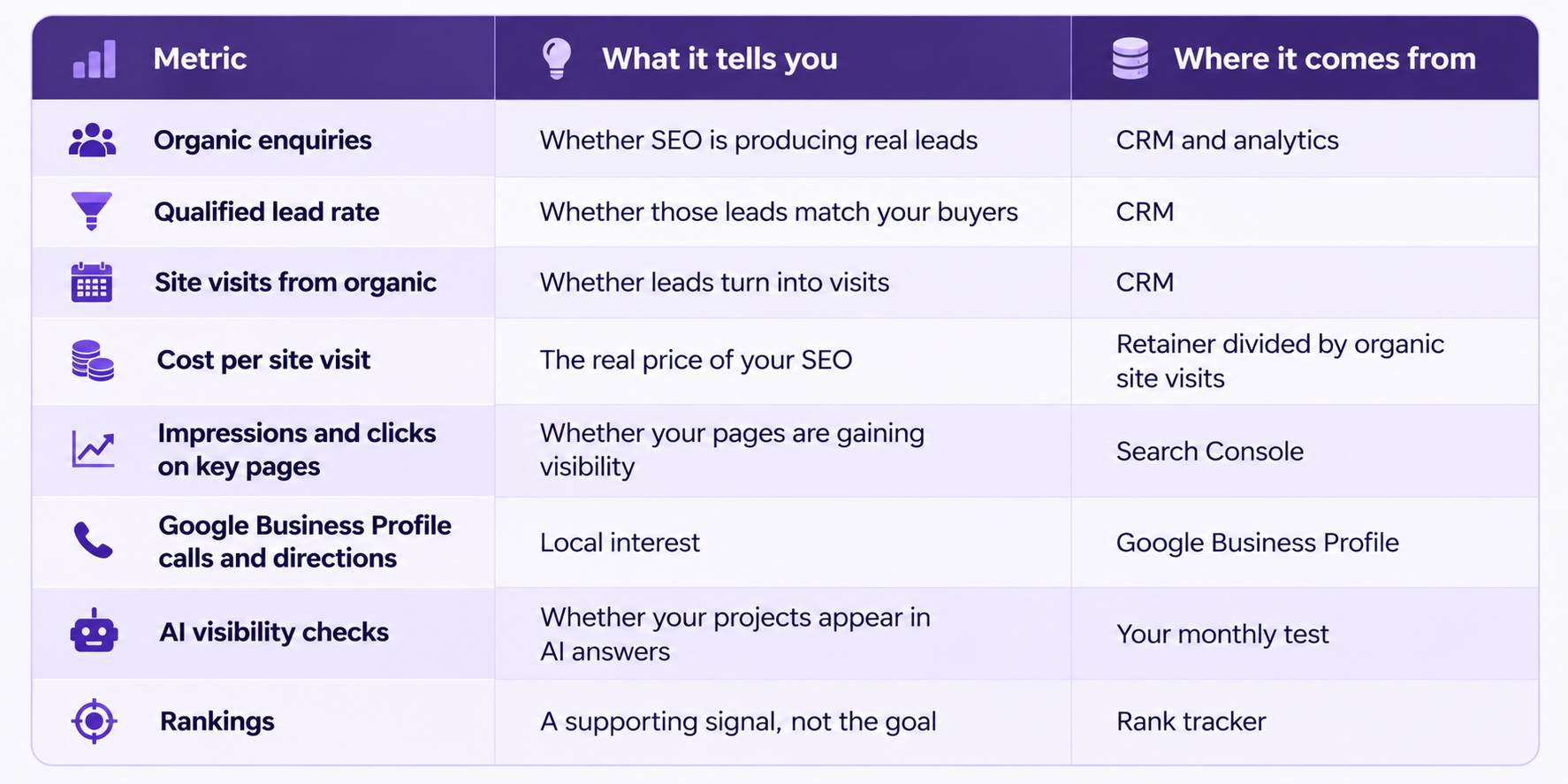
Tracking these metrics helps you understand whether your real estate SEO strategy is generating business results, not just increasing website traffic. Review the data monthly to identify which project pages attract potential buyers, which locations generate qualified enquiries, and where improvements are needed.
Focus on lead quality and conversions alongside organic visibility. For example, a page receiving fewer clicks but generating more qualified property enquiries may deliver greater business value than a page attracting high traffic with little buyer interest.
Use Google Search Console to monitor search impressions and clicks, analytics tools to understand website traffic, and your CRM to track enquiries through to site visits and sales. Review AI search visibility separately by testing relevant buyer questions regularly and recording whether your projects are mentioned or cited.
To follow leads properly, connect your site to a CRM. Our guide to the best real estate CRM explains how to choose one, and our post on how to generate real estate leads shows how SEO fits alongside other channels. Page speed matters here too, so see our Core Web Vitals checklist.
What are the red flags when hiring?
The biggest red flags when hiring a real estate SEO provider are guaranteed rankings, no access to your own accounts, doorway pages, reports that show only traffic, bought links and vague answers about what happens month by month. Any one of these is reason enough to look elsewhere.
- Guaranteed rankings. No one controls Google.
- No access to your own accounts. You should own Search Console, Analytics and your Google Business Profile.
- Doorway pages. Dozens of near-identical city pages are a risk, not a strategy.
- Reports that only show traffic or keyword positions.
- Bought links or "private networks". These can lead to penalties.
- Statistics borrowed from other countries and presented as Indian buyer data.
- Vague answers when you ask what happens in months one, three and six.
- Long lock-in contracts with no clear exit.
Is there a local advantage in NCR and Agra?
Yes. Local SEO for NCR and Agra works best when it reflects how people there actually search. Buyers often search by sector, society name, metro line or connectivity, and some use Hinglish or alternate names for the same area, such as Greater Noida West and Noida Extension. Good content and pages cover those variations naturally.
Adwizly has offices in Greater Noida West and Agra, which makes site visits and local reviews easier to arrange. Wherever you're based, ask a provider how they'll learn your micro-market, not just how they'll rank for it.
Which questions should you ask before hiring?
Before you hire, ask six questions: what happens in months one, three and six, which metrics you'll see, how project and locality pages will be planned, who owns your accounts, how RERA is handled and how AI visibility is tested. Clear answers are a good sign.
- What will you do in months one, three and six?
- Which metrics will you report, and can I see a sample report?
- How will you plan project, locality and configuration pages?
- Who will own my Search Console, Analytics and Google Business Profile?
- How do you handle RERA requirements on web pages?
- How do you test and improve visibility in AI search?
If a provider can't answer these clearly, keep looking.
How does SEO work alongside paid marketing?
SEO builds lasting visibility and paid campaigns deliver leads faster, so most new launches need both: ads for early momentum and SEO for the foundation that keeps enquiries coming when budgets change. Plan them together so each supports the other.
Our guide to the best marketing agency for real estate explains how to choose a partner across channels, and our Google Ads services and real estate social media marketing pages show how paid and social support SEO.
How Adwizly approaches real estate SEO
At Adwizly, we start with your projects and your sales process, then work out which pages and searches matter most. We fix the technical foundations, build project, locality and configuration pages that are genuinely useful, manage your Google Business Profile, and report on enquiries and site visits, not just rankings. We don't promise rankings, because nobody can.
If you'd like a team to handle it, see our real estate SEO services, or our wider SEO agency in India work. If you need more than search, our real estate digital marketing agency and real estate lead generation agency teams can plan the full mix. And if you're testing ideas before you commit, our guide to a performance marketing test plan can help.
Real estate SEO glossary
- AEO (answer engine optimisation): Shaping content so search engines and AI tools can lift a clear, direct answer from your page.
- GEO (generative engine optimisation): Making your content easy for AI tools to understand, trust and cite when they write answers.
- Locality page: A useful guide to a micro-market, covering connectivity, schools, hospitals, price trends and the projects available there.
- Configuration page: A page for a specific unit type in an area, such as 2 BHK, 3 BHK, villas or plots.
- Doorway page: A near-identical page, often one per city, made only to catch searches. It adds no value and can hurt your site.
- Google Business Profile: Your free Google listing for a staffed office or sales gallery. It drives map results, calls and directions.
- RERA: The Real Estate (Regulation and Development) Act, 2016, which sets registration and advertising rules for projects.
- Structured data (schema): Code that labels the facts on a page, such as your organisation, questions and answers, so machines read them correctly.
- Qualified lead: An enquiry whose budget, location and timeline match what you sell.
- Cost per site visit: Your monthly SEO spend divided by the site visits that came from organic search.
FAQs
- What is real estate SEO?
Real estate SEO is the practice of improving how property websites appear in search results, so that buyers find your projects and listings when they search. It combines technical fixes, project and locality pages, local search, content and links, with the aim of generating qualified enquiries and site visits.
- How is real estate SEO different from regular SEO?
Real estate SEO is more local, more regulated and more tied to specific inventory. It depends on locality and project pages, Google Business Profile, RERA-compliant content and long buying cycles. Regular SEO often focuses on products or services without those location, compliance and inventory constraints.
- What do real estate SEO services include?
They usually include a technical audit and fixes, project, locality and configuration pages, Google Business Profile management, content, link building, structured data, reporting and, increasingly, AI search optimisation. The exact scope depends on the number of projects, localities and the competitiveness of your market.
- What is a locality page in real estate SEO?
A locality page is a useful guide to a specific micro-market, covering connectivity, schools, hospitals, price trends and upcoming infrastructure, alongside the projects available there. It targets buyers searching by area. To be worth publishing, it must offer real information, not just the locality name swapped into a template.
- How much do real estate SEO services cost in India?
Published agency guides suggest basic local work starts around ₹8,000 to ₹20,000 a month, while competitive property markets commonly sit near ₹40,000 to ₹90,000 or more. Large multi-city programmes can reach several lakh. Ask for a written proposal that explains exactly what each tier includes.
- How long does real estate SEO take to show results?
Most programmes show early gains in three to six months and stronger, more durable growth in six to twelve. The timeline depends on competition, your site's condition and how quickly pages go live. Any provider promising top rankings in a few weeks for a competitive search should be treated with caution.
- Should I invest in SEO or Google Ads first for a launch?
For a launch, ads usually come first because they deliver enquiries within days, while SEO takes months. But waiting to start SEO costs you time you can't recover. Many developers run ads at launch and begin SEO in parallel, so organic visibility is ready as ad budgets taper.
- Can SEO replace paid ads for a new project?
Not in the short term. SEO builds slowly and works best for buyers who are already searching, while ads can create demand and fill early enquiries. Over a longer period, strong SEO can reduce your reliance on paid media, but most new projects benefit from using both.
- How do I choose the best real estate SEO company in India?
Compare providers against the same scorecard: real estate focus, tracking down to site visits, page planning, account ownership, AI search readiness, honest claims and RERA awareness. Ask for a sample report and a month-by-month plan. Shortlist three, and choose the one that answers most clearly.
- Specialist or generalist: which is better for real estate SEO?
A specialist usually understands project, locality and RERA requirements and gets up to speed faster. A strong generalist can still deliver if they learn your market and follow the right structure. Judge them on how well they explain property buyer behaviour, not on the label they use.
- Can an agency guarantee Google rankings?
No. Google's rankings depend on factors no agency controls, and Google itself says no one can guarantee a top position. A reputable provider will promise a method, transparency and effort, not an outcome. Treat guarantees of page-one results as a strong warning sign.
- What should a real estate SEO report show?
A good report shows organic enquiries, qualified leads, site visits and cost per site visit, supported by impressions, clicks, Google Business Profile activity and rankings. It should also explain what was done, what's next and what changed since the last report, in plain language you can verify.
- Does SEO work for a single project or a new launch?
Yes, but expectations should be realistic. A strong project page, a verified Google Business Profile and a few useful locality pages can bring organic enquiries within months. For the first weeks of a launch, ads typically deliver faster, so combining the two works best.
- Do brokers and agents need SEO?
Yes, especially local SEO. A verified Google Business Profile, strong reviews and useful locality guides help buyers and sellers find you directly, without relying entirely on portals. Even a modest, consistent effort can build a steady source of local enquiries over time.
- Should each project have its own website?
Usually not. A dedicated page on your main site pools authority and is easier to manage. A separate site can make sense for a large, distinct project with its own brand, but it needs its own content and links. Many separate sites end up thin and neglected.
- Does SEO work for plots, commercial and rentals?
Yes, though the approach changes. Plots rely on locality and connectivity content, commercial property on business-focused searches and trust, and rentals on fast-moving local listings. Each audience searches differently, so the pages, content and tracking should be planned separately for each.
- What is AEO and GEO in real estate marketing?
AEO (answer engine optimisation) and GEO (generative engine optimisation) mean shaping your content so search engines and AI tools can find, understand and quote it in direct answers. For real estate, that means clear project facts, consistent details, structured data and trusted sources, alongside normal SEO.
- Will ChatGPT or AI Overviews mention my project?
It's possible but never guaranteed. AI tools tend to draw on clear, consistent and well-sourced information. Publish accurate project fact sheets, keep details identical across your website and listings, and test regularly by asking buyer questions. Fix anything wrong and track whether your visibility improves.
- What RERA rules apply to project pages?
In general, a project must be registered before it's advertised, and the registration number must appear on advertisements and on the website. Claims must also be accurate, since false statements can create liability. Rules and expectations vary by state, so confirm the details with your RERA authority or legal adviser.
- Why is Google Business Profile important for real estate?
It puts your sales gallery or office on the map for "near me" and local searches, and it can drive calls and directions directly. Reviews, photos and updates build trust. It works best for staffed locations that buyers can really visit, with details matching your website.
- What are the top 5 real estate companies in India?
It depends on the measure. By sales bookings in the first nine months of FY26, PTI-reported company filings put Godrej Properties, Prestige Estates, DLF, Lodha Developers and Signature Global at the top, while DLF is the largest by market capitalisation. Rankings change every quarter, so check the latest filings. Smaller developers can still win on locality and project searches.
- Which SEO company is the best in India?
There's no official ranking, and lists that put their own publisher first aren't evidence. The best company for you depends on your industry, budget and goals. Shortlist three providers, score them on the same criteria, and ask each for a sample report before you decide.
- Which SEO company is best?
The best SEO company is the one whose experience, process and reporting fit your business. For real estate, that means property knowledge, tracking down to site visits and honest claims. Be wary of anyone who names themselves the best without showing how they measure results.
- How to do SEO for real estate?
Start by fixing your site's technical basics, then build a strong page for each project, useful locality and configuration pages, and a verified Google Business Profile. Add helpful content, earn genuine links, track enquiries and site visits in your CRM, and follow RERA rules throughout.
- What is the 80/20 rule in SEO?
It's the Pareto principle applied to SEO: roughly 20 percent of your pages, keywords or actions tend to produce 80 percent of your results. It's a rule of thumb, not a law. For real estate, that usually means your project pages, key locality pages and Google Business Profile.
- Is SEO dead now with AI?
No, but it's changing. AI summaries can answer simple questions without a click, so some traffic has shifted. Buyers still need trusted sources, and AI tools draw on web content. SEO now includes making your facts clear and quotable, as well as earning rankings and clicks.
- Is SEO dead or evolving in 2026?
It's evolving. Search now includes AI-generated answers, maps, and conversational results alongside traditional listings, so the work is broader than keywords and links. Studies of how AI affects clicks vary, so judge by your own results: enquiries, site visits and visibility in the places buyers look.
- Will SEO exist in 5 years?
Nobody can predict it precisely, but the need is unlikely to vanish. People will still need to find trustworthy information, and AI tools will still rely on content from the web. The name and tactics may change, while the core job of being clear, useful and credible stays.
- How much does SEO usually cost?
It varies widely with scope, competition and who does the work. Simple local SEO can cost a few thousand rupees a month, while large, competitive programmes can cost several lakh. The most useful measure is cost per outcome, such as cost per qualified enquiry, not the monthly fee.
- How much does SEO cost in India?
Published guides from Indian agencies put it at roughly ₹8,000 a month for basic local work and up to ₹3 lakh or more for enterprise programmes. Most small and mid-sized businesses fall somewhere in between. Always ask for a written scope, so you can compare proposals fairly.
- How much does real estate SEO cost?
Because real estate is competitive and page-heavy, published guides usually place it near ₹40,000 to ₹90,000 or more a month for serious programmes, with simpler local work costing less. Your price depends on the number of projects, localities, content volume and reporting depth.
Sources and notes
We wrote this guide from our own experience and the public sources below, all accessed in October 2026. Cost ranges come from agency-published guides, which are marketing pages, so treat them as indicative. We haven't used client results in this guide.
- RERA advertisement requirements: a state authority's summary of Sections 3, 11 and 12 of the RERA Act. Check your own state authority for local rules.
- SEO services cost in India: upGrowth's pricing tiers for Indian SEO.
- SEO cost in Mumbai, 2026 pricing guide: Prateeksha's ranges, including competitive niches such as real estate.
- SEO cost in Pune, 2026: Nysa Digital's ranges for competitive categories.
- Top listed developers by pre-sales, FY26: PTI-reported company filings, published March 2026.
This guide is for information only. It isn't legal advice, so confirm RERA requirements with your legal adviser.
Want a real estate SEO plan built around your projects?
If you'd like a clear scope, a month-by-month plan and reporting that follows enquiries to site visits, talk to our real estate SEO team. We'll look at your current setup together, whether or not you end up working with us.
© 2026 Adwizly, a digital growth agency for real estate and EdTech brands. Real estate SEO services